
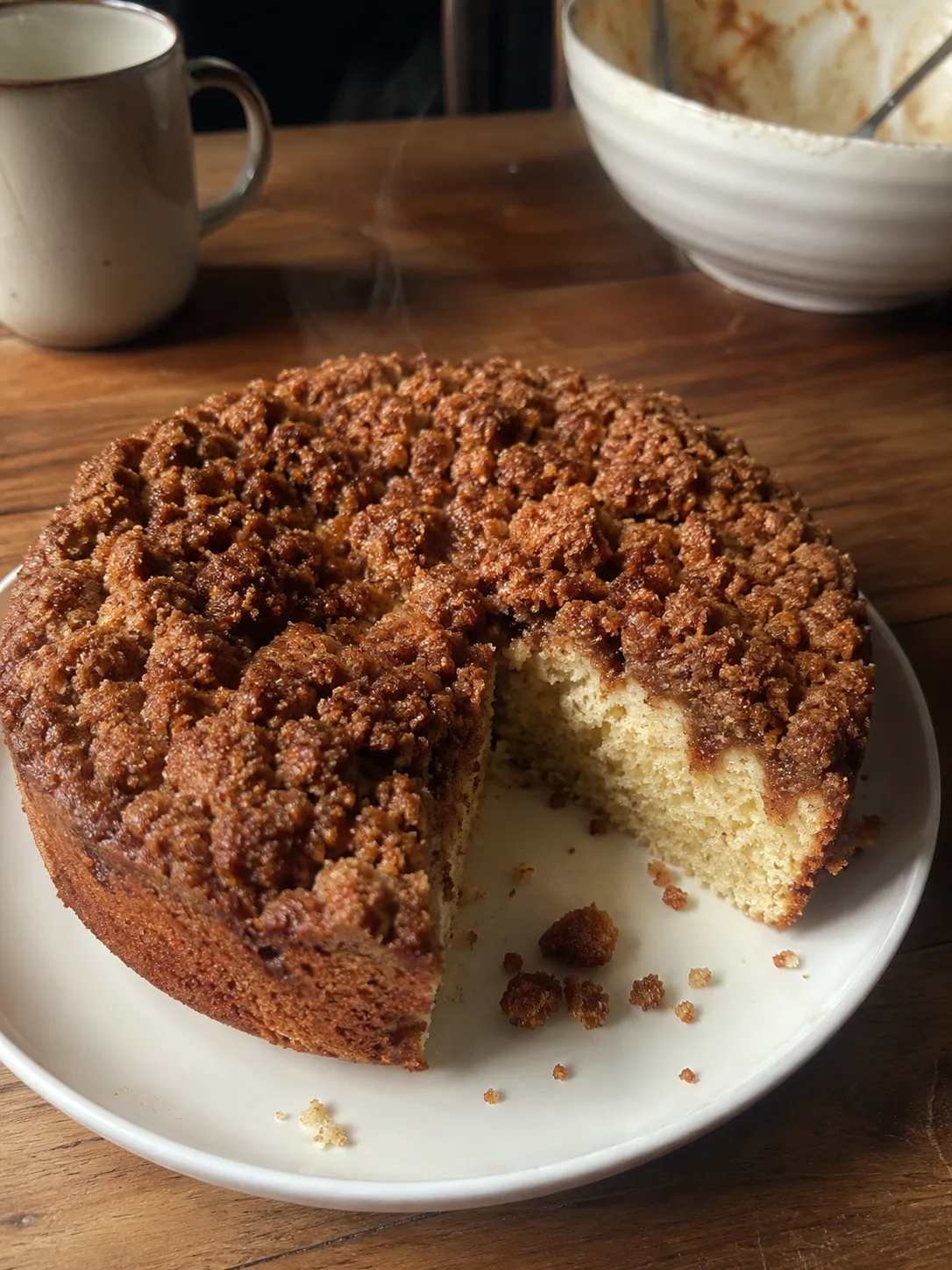
The first one I made came out with a topping the color of a roasted coffee bean and a cake underneath that was still wet. The second one I turned the temperature down for, and the streusel sank into the batter and vanished, so what I had was a plain cake with a faint brown stripe through the middle of it.
The third one I opened the drawer on at eight minutes to check, and a small drift of crumbs went up off the surface and stuck to the element, where they smoked for the rest of the bake.
Three different failures, one cause, and it is not the recipe. It is that a streusel topping is the worst possible thing to put on top of a cake in a basket air fryer, and every recipe for this asks you to put it on at the beginning anyway.
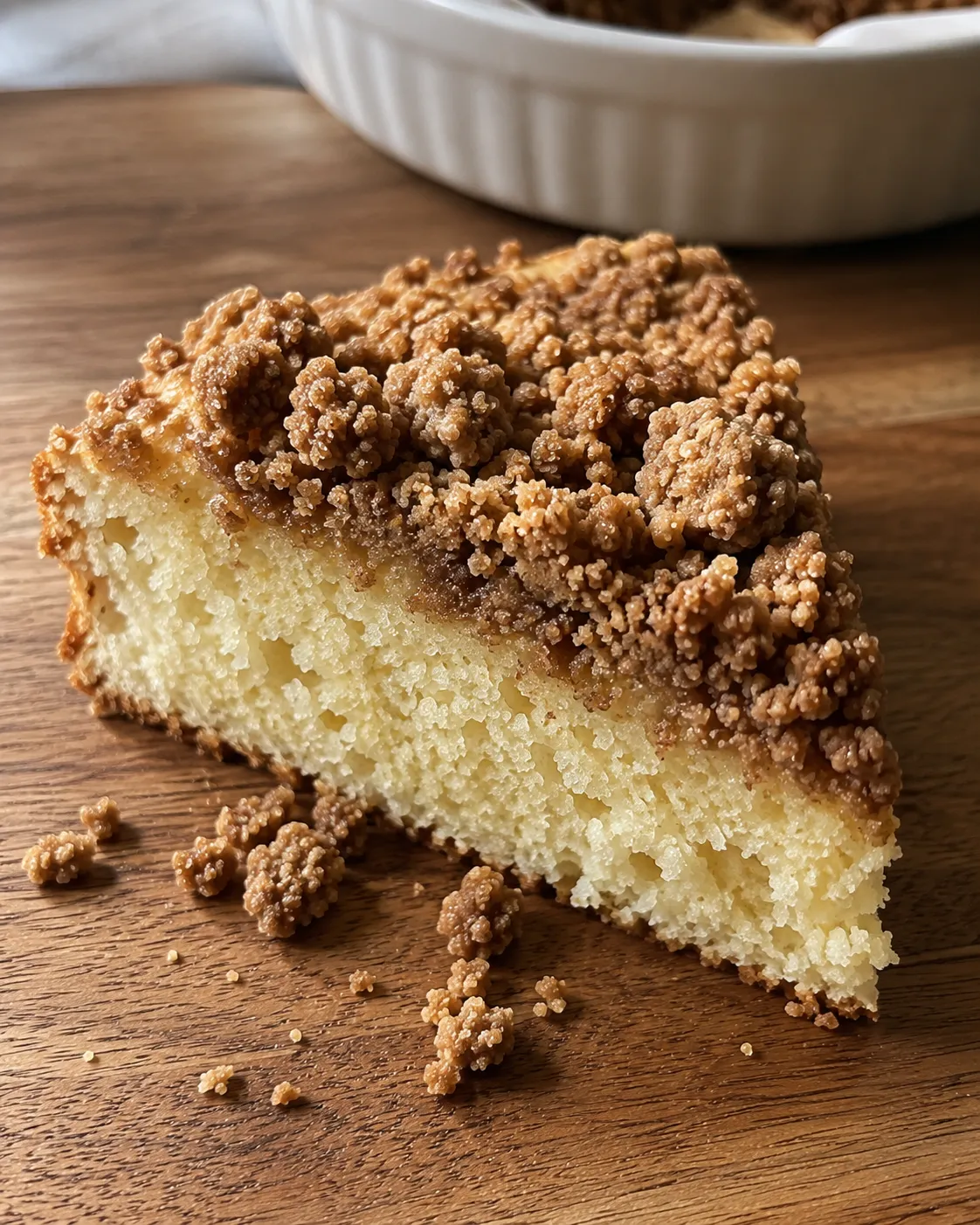
Quick answer: Bake the cake naked for the first 16 minutes at 320°F in a 6-inch pan. Then scatter the streusel on and give it another 10 to 16 minutes, until the middle reads 200°F. Making the streusel with melted butter rather than cold rubbed-in butter gives you clumps instead of sand, and clumps do not blow around. That is the whole thing. No foil, no lowering the temperature, no sunken topping.
Two cakes, one name, and only one of them has coffee in it
Worth clearing up first, because it explains why the recipes you find for this contradict each other so completely.
Search this term and you land on two genuinely different desserts, and neither camp ever mentions that the other exists.
| Version | What it is | Coffee in it? |
|---|---|---|
| American coffee cake | A plain, tender, sour cream cake with a cinnamon streusel layer. Eaten at breakfast. This page. | None at all |
| British coffee cake | A coffee-flavored sponge, usually with coffee buttercream. A proper afternoon cake. | Yes, usually instant |
The American one is named for what you drink alongside it, not what is in it. So if you searched this expecting to taste coffee, you want the second row and this is not that recipe. The temperature and timing sections below still apply to both, since a plain sponge in a 6-inch pan behaves the same whatever is flavoring it.
This also explains a spread in the published times that looks impossible at first glance. I found recipes for air fryer coffee cake calling for 12 minutes and recipes calling for 70 minutes. Some of that is the two different cakes. Most of it is pan depth, which is the section further down.
The streusel is the problem, not the cake
The cake part of a coffee cake is unremarkable and it behaves in an air fryer exactly like any other small cake. Our air fryer vanilla cake is essentially the same batter without the topping, and it is not a difficult bake. Everything that makes coffee cake harder is sitting on top of it.
Think about what streusel actually is. Flour, sugar and butter, worked into loose crumbs, spread in a layer on the surface. Now put that in a basket, where the heating element sits two to four inches above it and a fan pushes air down onto it at speed. Three things follow, and they are all bad.
It is the closest thing to the element
The topping is the highest point in the pan, so it takes the most radiant heat of anything in the machine, and it takes it for the entire bake.
And it is the only dry thing there
Wet batter cannot go above 212°F while there is still water in it. Streusel has almost no water, so nothing holds its temperature down and it climbs freely.
And it is loose
Individual crumbs weigh almost nothing. A fan that can lift a sheet of parchment has no trouble at all with a scattering of dry crumbs.
The second one is the one that actually burns your cake and it is worth understanding properly, because it is the same mechanism that catches people out on our air fryer apple fries.
A cake batter surface is protected by its own water. Evaporation holds a wet surface near boiling until the water is gone, which is why the exposed top of a plain cake browns slowly and gently. The glossary covers this under the 212 degree ceiling. Streusel has no such protection. It is flour and sugar and fat with barely any moisture in it, so from the moment the pan goes in, the crumbs are free to climb toward whatever the air is doing. Sucrose starts to caramelize around 320°F and brown sugar goes sooner than that, so at any temperature that bakes the cake in a reasonable time, the topping is already in the danger zone.
This is why the usual fixes do not work. Turning the temperature down means the cake takes longer, which means the streusel spends longer up there, so you gain very little. Tenting with foil from the start blocks the browning entirely and you get pale, raw-tasting crumbs. And covering a loose topping with foil in a basket has its own problem: the foil has to be pressed down over the rim or the fan lifts it, and pressing it down flattens the streusel into a crust. Every one of these treats the symptom.
So put it on later
The topping does not need thirty minutes of heat. It needs about ten. All the extra time is doing is damage.
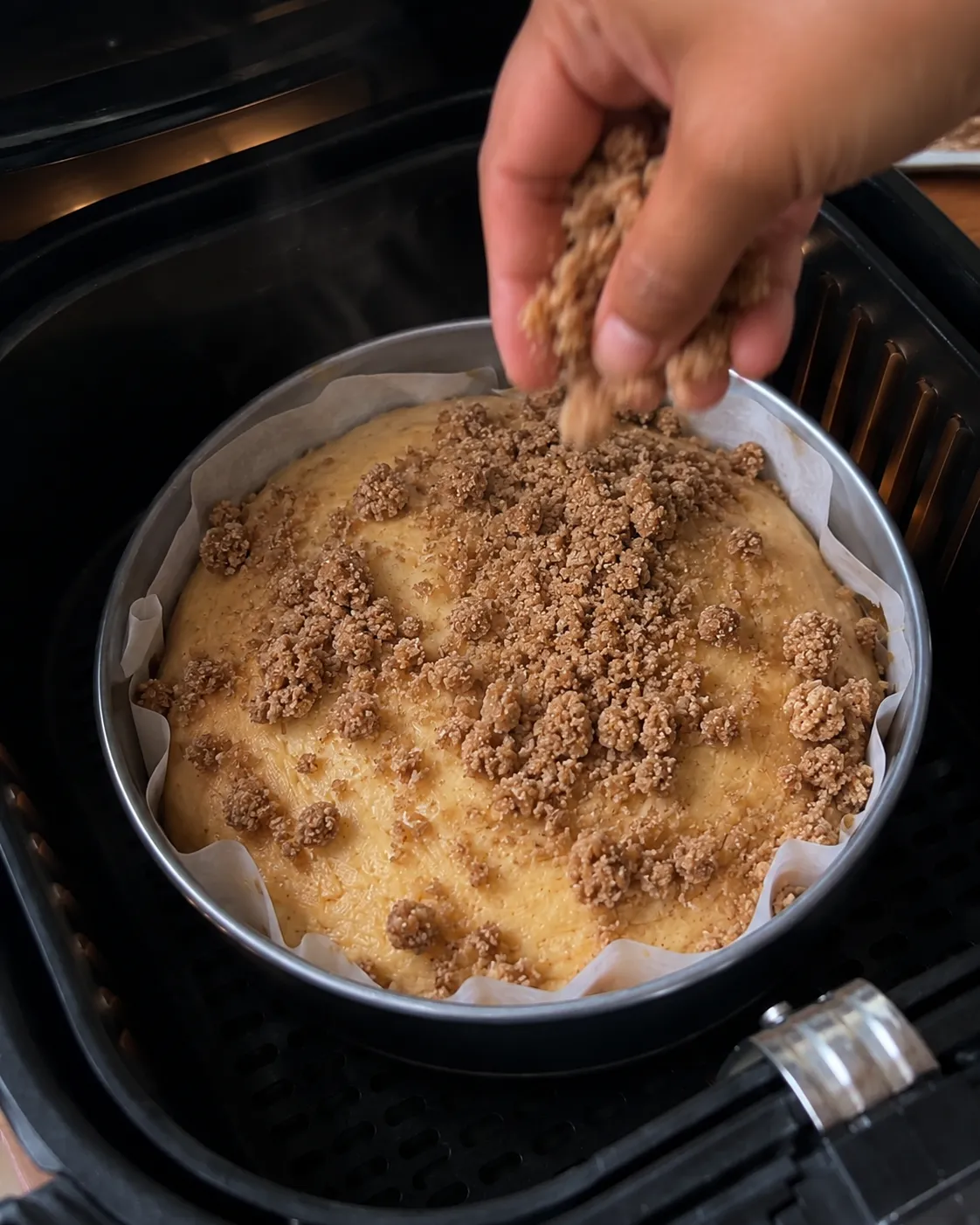
So bake the cake on its own for the first two thirds, open the basket, scatter the streusel over the set surface, and finish. One change, and it fixes all three problems at once rather than trading one for another.
| Problem | Streusel on at the start | Streusel on at 16 minutes |
|---|---|---|
| Burning | 26 to 32 minutes of direct radiant heat on dry sugar | About 10, which is enough to brown and not enough to scorch |
| Sinking | Dropped onto liquid batter, so it sinks as the cake rises around it | Lands on a set surface. It cannot sink into something solid |
| Blowing around | Loose crumbs on a wet surface for the full bake, right under the fan | Warm, tacky surface grips them, and there is far less time to be blown |
Sinking is the one people usually blame on the batter being too thin, and it is not. It is timing. A streusel dropped onto batter that has not set yet is denser than the batter around it and gravity does the rest while the cake rises past it.
Is it safe to open the basket partway through?
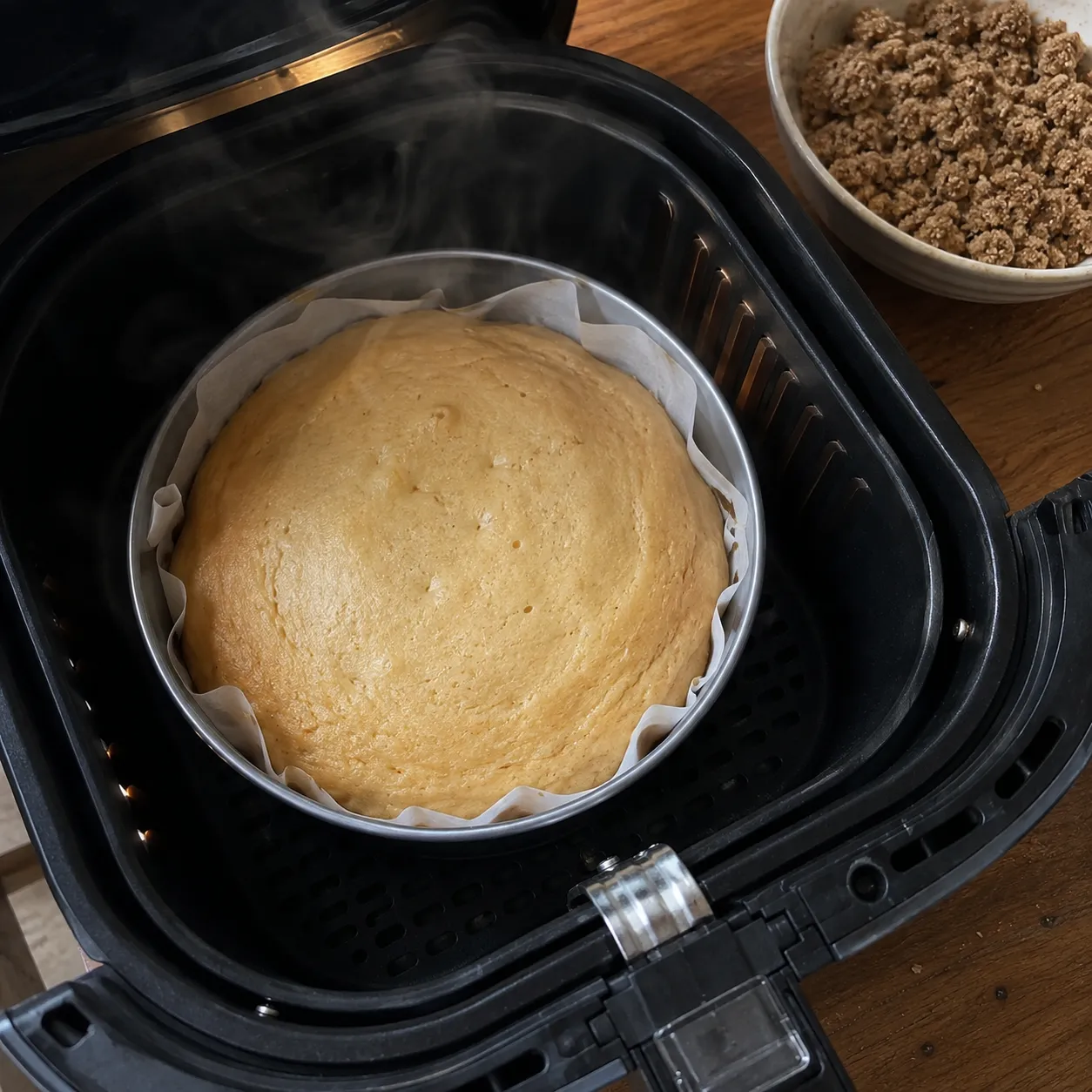
At sixteen minutes, yes. Earlier than that, no, and the distinction matters.
Opening a basket drops the air temperature sharply and the machine takes a minute or two to rebuild it. Do that in the first ten minutes, while the batter is still rising and its structure is still liquid, and the cake can collapse. By sixteen minutes the surface has set, the crumb has formed, and the cake is no longer relying on hot air to hold its shape. A ten second opening at that point costs you nothing but a little heat, which is why the recipe below gives a range rather than a single number for the second stage.
Work quickly and have the streusel already made and sitting in a bowl before you start the bake. This is not the moment to be measuring brown sugar.
Melted butter, not rubbed in
Most streusel recipes have you rub cold butter into the flour and sugar with your fingertips, the way you would for a crumble. That is correct for an oven and it is the wrong choice here.
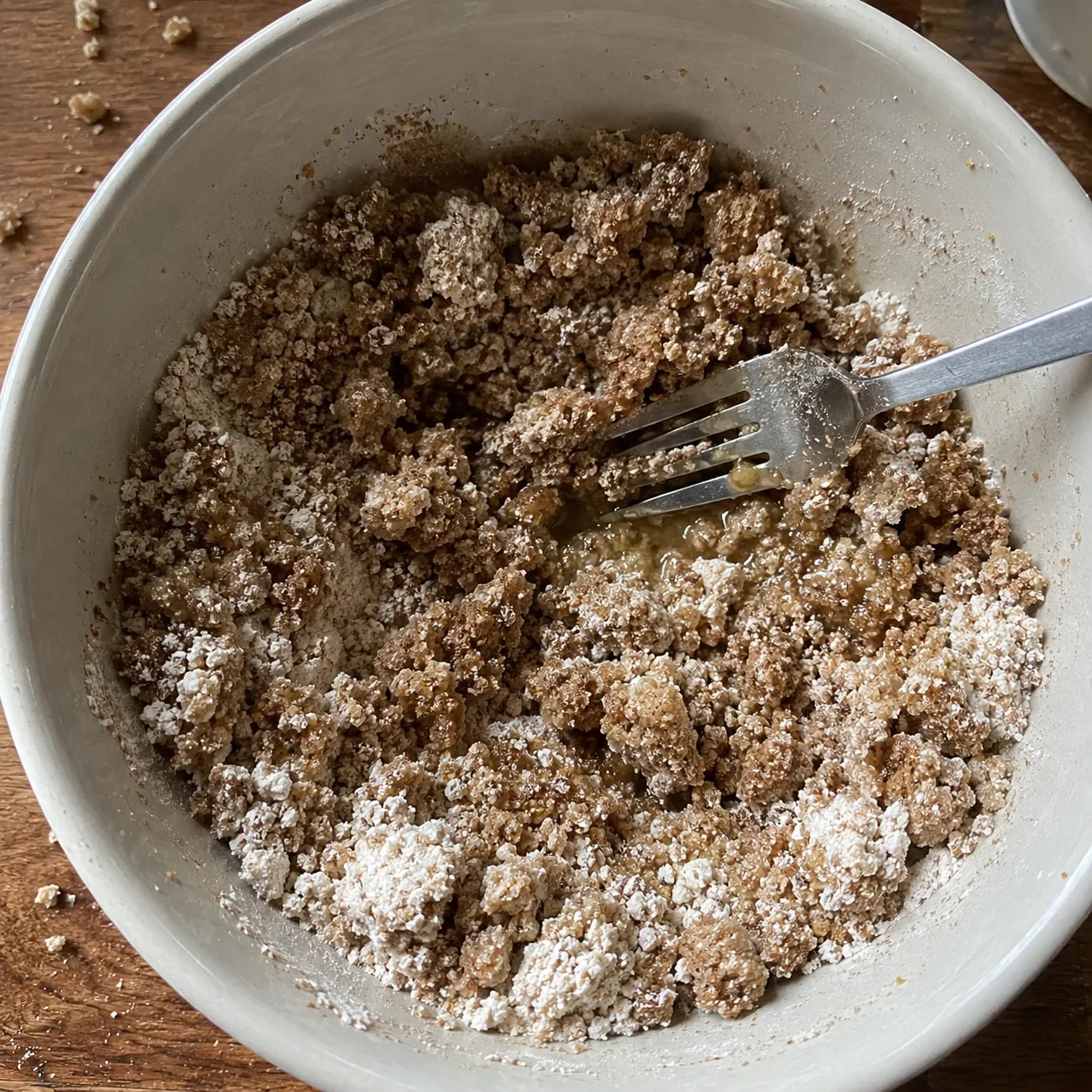
Rubbed cold butter gives you a fine, sandy, even crumb. Melted butter stirred in with a fork gives you uneven lumps, some the size of a pea and some bigger. In an oven the sandy version is arguably nicer. In a basket the lumps win, for a reason that has nothing to do with flavor.
- Weight. A pea-sized clump has many times the mass of a grain of sand and the same air moving over it. Clumps stay where you put them.
- Surface area. Sand has enormous surface for its volume, which is exactly the shape that browns fastest. Lumps brown on the outside and stay soft in the middle, which is what you want anyway.
- It does not pack down. Fine crumbs settle into a solid sheet that steams the cake surface underneath. Clumps leave gaps for steam to escape.
Melt the butter, pour it over the dry ingredients, and stir with a fork for about ten seconds. Then stop. If it looks uneven, it is right. Squeeze a few of the bigger pieces together with your fingers if you want proper craggy lumps on top.
What actually fits, and the 12 to 70 minute question
Two of the most-shared recipes for this call for an 8 by 8 or 9 by 9 inch baking dish. A 9 by 9 does not fit in any basket air fryer I have ever seen, and an 8 by 8 only fits a few of the largest. Those recipes are written for oven-style units without saying so, and if you own a basket you will get halfway through mixing before you find out.
This recipe is written for a 6-inch round pan, which fits a typical 5 quart basket with room for air to move around it.
| Pan | Batter depth | 320°F | Notes |
|---|---|---|---|
| 6-inch round | About 1 inch | 26 to 32 min | The recipe as written. Streusel at 16 minutes |
| 7-inch round | About 3/4 inch | 22 to 28 min | Shallower, so faster. Streusel at 13 minutes |
| 7-inch springform, deep | 2 inches or more | 45 min and up | This is where the 70 minute recipes come from |
| 8x8 square | About 3/4 inch | 22 to 28 min | Only if it clears the basket with an inch of airflow |
| 9x9 square | About 1/2 inch | Oven-style only | Will not fit a basket. Use the oven |
That is the whole of the 12 to 70 minute spread, and it is depth rather than machine variation. Heat moving through batter takes time that goes roughly with the square of the distance it has to travel, so a cake twice as deep does not take twice as long, it takes about four times as long. A shallow 9 by 9 and a deep springform are not the same bake even at the same temperature. The pan size calculator will tell you what your basket actually takes if you have never measured it, and the recipe scaler converts the batter quantity if you go up or down a size.
If you are working from an oven recipe rather than starting here, run its numbers through the air fryer calculator to get the temperature, then ignore the time it hands you and go by the internal reading further down. The oven to air fryer conversion guide has the general rules if you do this often. And do not skip the streusel timing, because no conversion tool knows the topping exists.
An oven-style unit with a flat shelf changes this section considerably, since it takes a full-size pan and the element sits much further away. Basket versus oven-style goes through where each one wins, and a streusel-topped cake is one of the clearer cases for the oven-style. If you are shopping rather than working with what you already own, the best air fryers for baking goes through which models leave enough clearance above a topped cake.
Ingredients
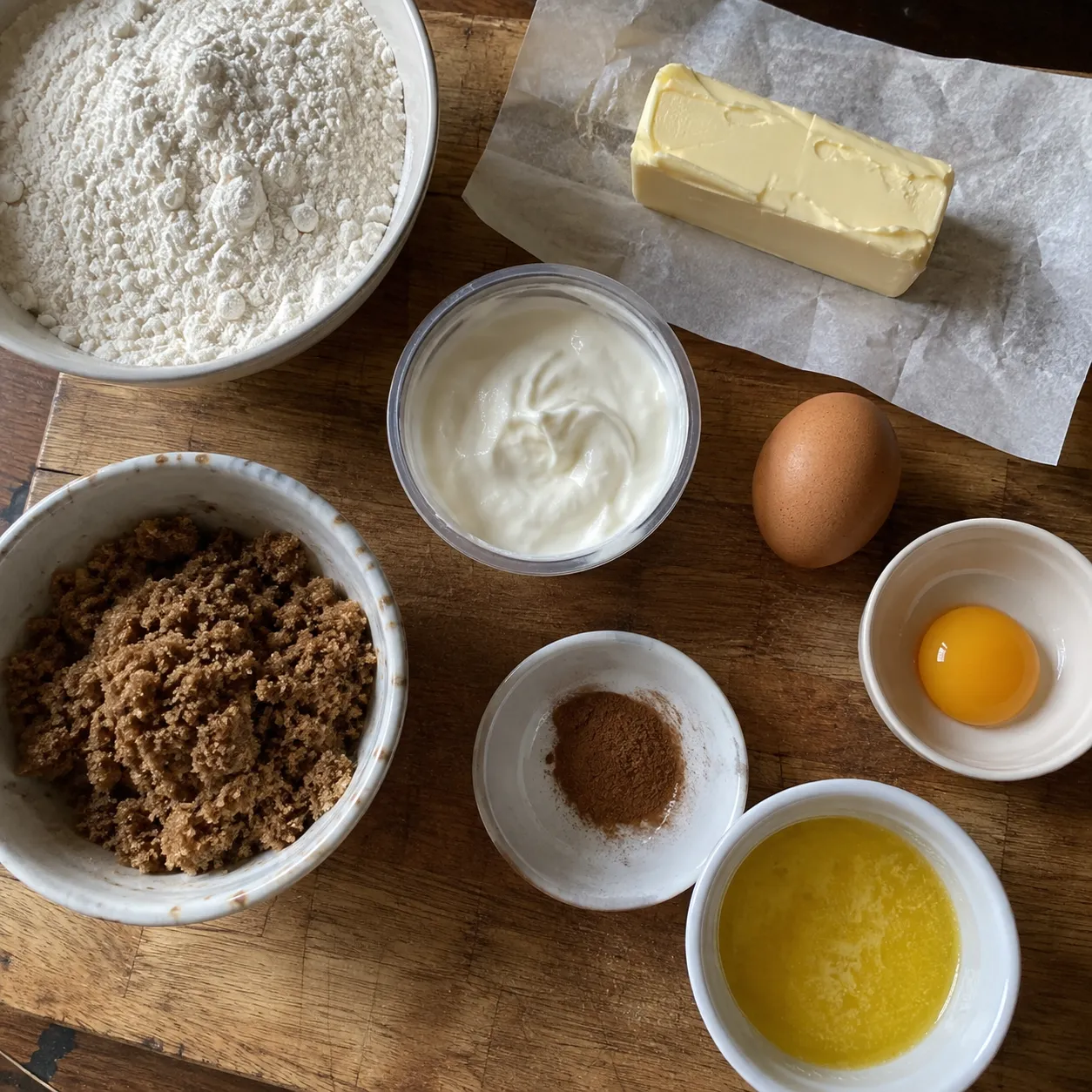
One 6-inch coffee cake, six slices. Everything at room temperature, and here that is load bearing: cold sour cream dropped into creamed butter seizes it into lumps that never smooth out. The glossary covers that failure under curdling.
For the cake
- 1 cup (125g) all-purpose flour
- 1/2 cup (100g) granulated sugar
- 3/4 teaspoon baking powder
- 1/4 teaspoon baking soda
- 1/4 teaspoon salt
- 1/4 cup (57g) unsalted butter, softened
- 1 large egg plus 1 yolk, room temperature
- 1/2 cup (120g) full-fat sour cream, room temperature
- 1 teaspoon vanilla extract
For the streusel
- 1/3 cup (42g) all-purpose flour
- 1/3 cup (67g) light brown sugar, packed
- 1 teaspoon ground cinnamon
- Pinch of salt
- 3 tablespoons (42g) unsalted butter, melted
Three notes
- Full-fat sour cream, not light. Light sour cream is mostly water with gums in it, and the fat is what makes this crumb tender enough to be worth eating cold the next morning. Full-fat Greek yogurt is a fair swap. Buttermilk works too, though the cake comes out slightly less rich.
- Light brown sugar in the streusel, white in the cake. The molasses in brown sugar is most of what makes a streusel taste like streusel rather than like sweet flour. It also browns sooner, which is another argument for putting it on late.
- The extra yolk. A 6-inch cake is a small amount of batter and a whole extra egg would make it springy. A yolk on its own brings fat and emulsifier without the water in the white, the same reasoning as the extra yolk in our air fryer carrot cake.
How to make it
- Make the streusel first and leave it in the bowl. Whisk the flour, brown sugar, cinnamon and salt, pour the melted butter over, and stir with a fork for about ten seconds. Stop while it is still uneven. You want this ready before the cake goes in, because you will be adding it mid-bake.
- Line the pan. A parchment circle in the base and a light grease up the sides, trimmed so nothing stands proud of the rim. Foil and parchment in an air fryer covers why a loose edge is a problem, and it matters more here than usual because you will be opening the basket partway through. A coffee cake is served in slices from the pan or turned out whole, and either way you want it to release cleanly.
- Preheat to 320°F (160°C) for 3 minutes. Whether you need to preheat covers why a leavened batter cares about this.
- Whisk the dry ingredients: flour, baking powder, baking soda and salt.
- Cream the butter and sugar for about 3 minutes, until it is noticeably paler and no longer grainy. More on creaming in the glossary.
- Beat in the egg and the yolk, one at a time, just until each disappears.
- Add the sour cream and vanilla, then the dry ingredients, mixing on low and stopping the moment the last streak of flour is gone. Overmixing builds gluten and this cake wants very little of it.
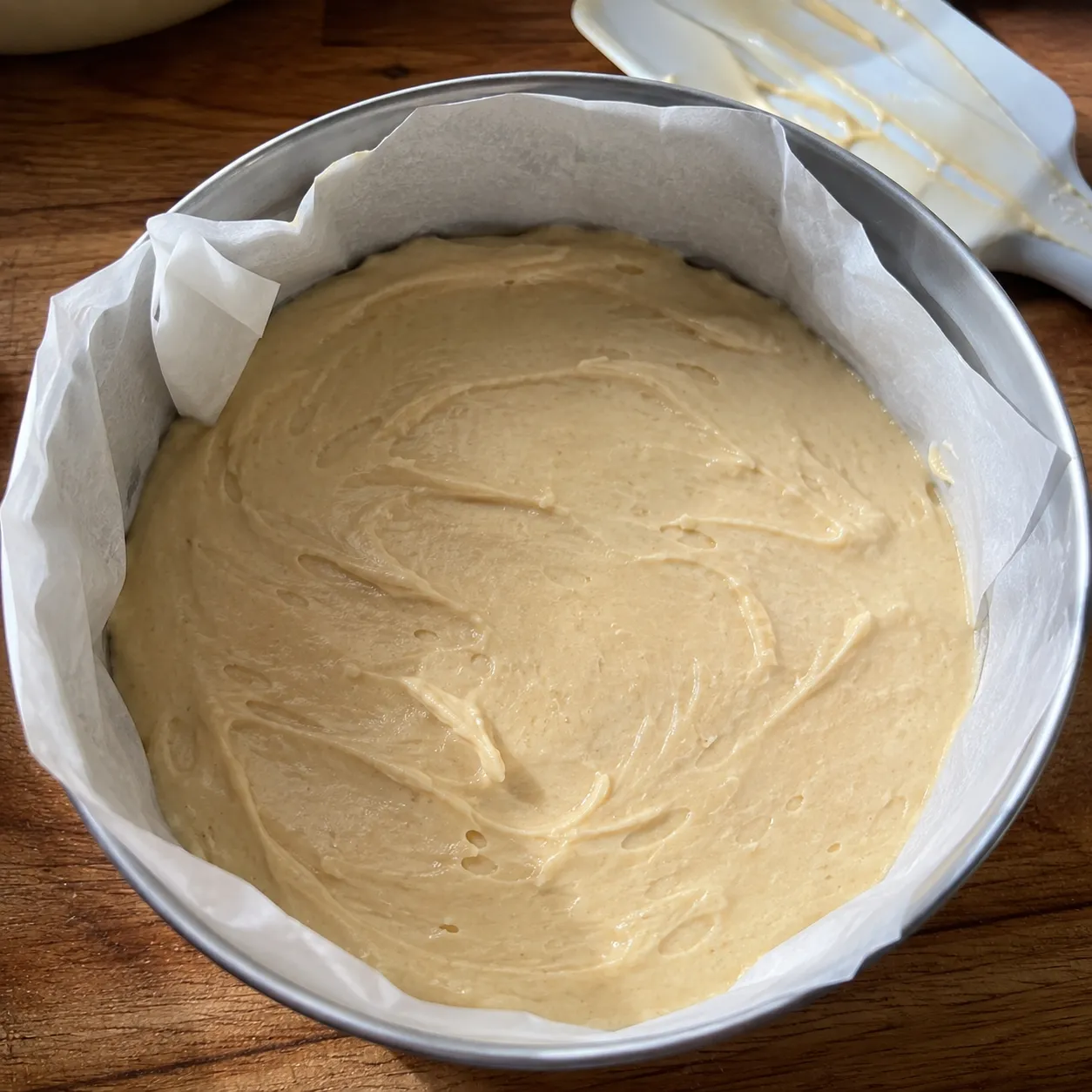
- Scrape into the pan and level the top. It should come no more than halfway up. See fill level.
- Bake 16 minutes at 320°F with no topping. Do not open it during this part. The surface needs to set.
- Open, scatter the streusel evenly over the top, and close. Ten seconds. Do not press it down. If your machine has a hot spot, turn the pan 180 degrees while it is open, the same move our air fryer cupcakes page makes the case for.
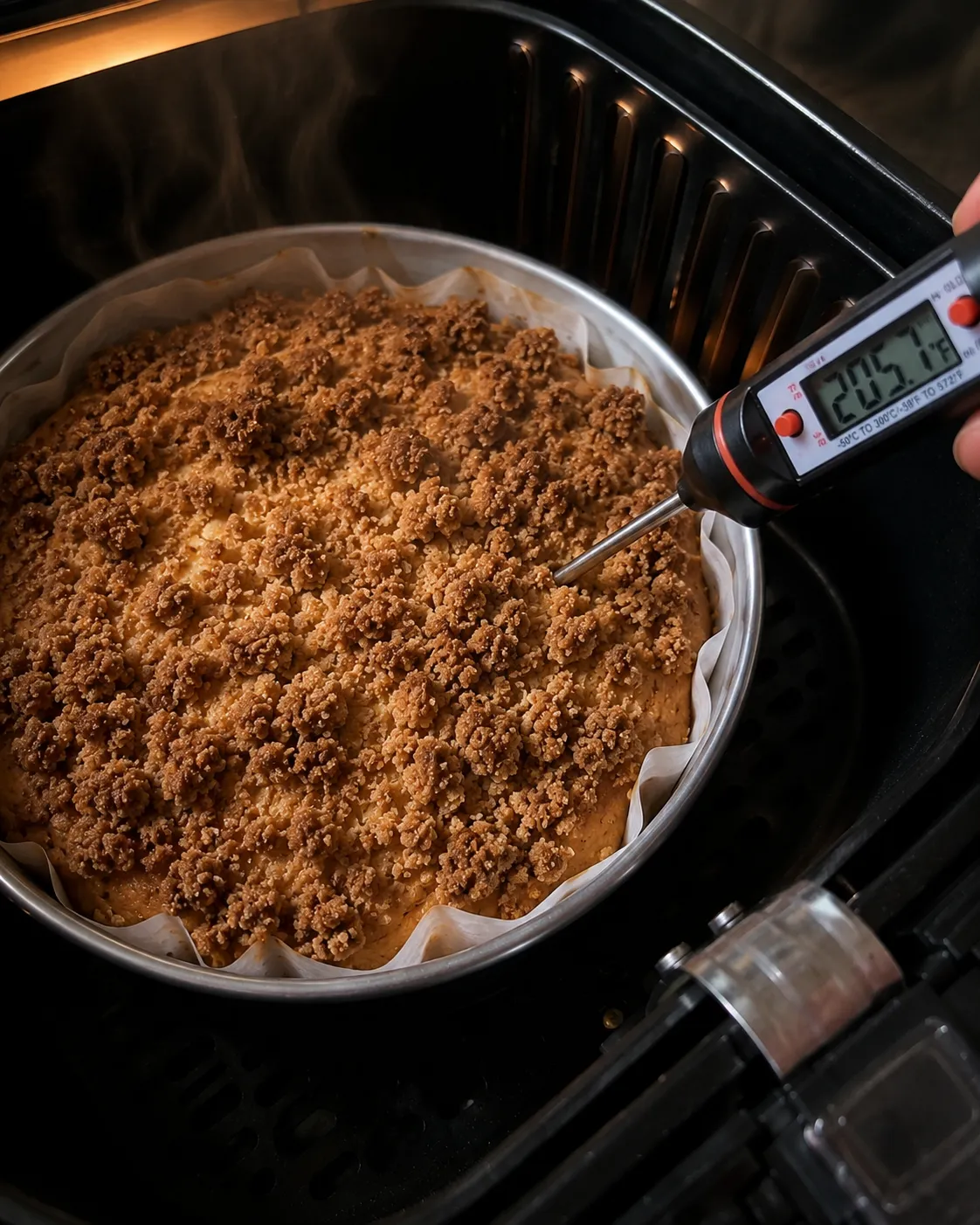
- Bake another 10 to 16 minutes, until the streusel is golden and the middle of the cake reads 200°F.
- Cool in the pan 15 minutes, then lift it out on the parchment. The streusel is fragile while it is hot and firms up as it cools.
- Glaze once completely cool, if you are glazing. Warm cake turns a glaze into a puddle.
Why 320°F and not 350. Most oven coffee cake recipes say 350°F, and in an oven that is right, because the element is a foot away and the topping is in no particular danger. In a basket the element is inches above the streusel, and every degree you add goes to the topping first. 320°F is low enough that the crumbs brown rather than scorch during their ten minutes up there, and the cake underneath does not care, because it is being cooked by conducted heat from the pan rather than by radiant heat from above.
200°F, and why the toothpick is awkward here
Every recipe for this finishes on a clean toothpick, and on a coffee cake specifically that test has a problem beyond the usual one.
To reach the cake you have to push the toothpick down through the streusel. It comes back out through the streusel too, and it collects buttery crumbs on the way, so it looks wet when the cake underneath is fine. People read that as underdone and give it another few minutes, and those few minutes are spent on the one part of the cake that cannot afford them.
| Reading | What you have |
|---|---|
| Under 190°F | Not set. Another 3 minutes. |
| 195°F | Nearly. Two more minutes. |
| 200°F | Done. Take it out. |
| Past 208°F | Dry, and the streusel will have gone past golden as well. |
Push the probe in at an angle from near the edge rather than straight down through the middle of the topping, so the hole ends up somewhere the streusel covers. Take one reading and pull it out. An instant-read thermometer costs about as much as two coffees and it settles this in three seconds. Internal targets for everything else on the site are in the air fryer baking chart.
If you are going to use a toothpick anyway, go in at an angle from the side so it passes through cake rather than topping, and judge it on what comes off the middle of the stick rather than the tip.
Fixing what goes wrong
| What you got | Why | Fix |
|---|---|---|
| Dark, bitter topping over a wet cake | Streusel on from the start, taking radiant heat for the whole bake. | Add it at 16 minutes. This is the whole page. |
| Streusel disappeared into the cake | It went onto liquid batter and sank as the cake rose past it. | Add it once the surface has set. It cannot sink into a solid. |
| Crumbs blew onto the element and smoked | Fine sandy streusel plus a fan, usually made worse by opening early. | Melted butter for clumps, and leave it closed for the first 16 minutes. |
| Topping packed into a hard sheet | Foil pressed down onto it, or the crumbs were too fine. | No foil at all with this method. Clumps, not sand. |
| Cake dry, topping fine | Past 200°F, usually chasing a clean toothpick through the streusel. | Thermometer, in at an angle from the edge. See avoiding dry bakes. |
| Sank in the middle | Opened the basket too early, or pulled it before the structure set. | Nothing before 16 minutes, and 200°F. See why cakes sink. |
| Lumpy, curdled looking batter | Cold sour cream into creamed butter. | Room temperature. If it splits, a tablespoon of the flour brings it back. |
| Tough and chewy | Overmixed after the flour went in. | Stop at the last streak of flour. |
| Batter overflowed | Pan filled more than halfway. | Half is the ceiling. Bake the extra as a couple of muffins. |
If burning is a pattern across different bakes rather than just this one, how to prevent burning in an air fryer covers the causes, and the troubleshooting guide has the rest, including the loose-topping problem in its own right.
Variations
- Cinnamon swirl through the middle. Half the batter, a tablespoon of the streusel mix scattered over it, then the rest of the batter. Do not stir it. This one goes in at the start because it is buried, and buried streusel is in no danger from anything. Our air fryer bundt cake runs the same swirl through a ring pan.
- Nuts. A quarter cup of chopped pecans or walnuts in the streusel. Add them with the melted butter so they get coated, otherwise they toast faster than the crumbs and turn bitter.
- Blueberry. A scant cup, tossed in a teaspoon of the flour first so they do not sink. Add 2 to 3 minutes and still go to 200°F.
- Apple. One apple, diced small and cooked down in a pan for five minutes first, the same way our air fryer apple cake handles it. Raw apple brings a lot of water into a small cake.
- Actual coffee, if that is what you came for. Two teaspoons of instant espresso powder dissolved in a tablespoon of hot water, stirred in with the vanilla. It will not taste strongly of coffee at that dose, it just deepens everything else.
- Simple glaze. Half a cup of powdered sugar with two or three teaspoons of milk, thick enough to fall off a spoon in a ribbon. Over the cooled cake, in lines rather than poured, so the streusel still shows.
- Box mix shortcut. A yellow cake mix works, and the streusel timing is unchanged because it is set by the topping rather than the batter. Our boxed cake mix guide has the times and temperatures by format, and a box makes about twice what a 6-inch pan wants.
For more things worth eating at breakfast out of a basket, air fryer banana bread and air fryer pumpkin bread are the two I make most, air fryer banana muffins are faster than any of them, and air fryer cinnamon rolls scratch a similar Sunday itch.
If you want a plainer cake out of the same 6-inch pan, air fryer chocolate cake and air fryer pound cake both use it and neither has a topping to time.
Storage and reheating
- Room temperature: 3 days in an airtight container, once completely cool. The sour cream keeps it soft longer than a plain butter cake.
- Cover it loosely for the first few hours, or not at all. A sealed container while there is still any warmth in it puts steam onto the streusel and softens the crumbs you worked to keep crisp.
- Do not refrigerate. A fridge speeds up starch retrogradation, which is the technical name for cake going stale, so the counter is genuinely better.
- Frozen: 3 months, unglazed, wrapped in plastic then foil. Thaw at room temperature still wrapped.
- Reheating a slice: 2 to 3 minutes at 320°F. This is one of the few things an air fryer reheats better than a microwave does, because it dries the streusel back out instead of steaming it soft.
Half an hour of air fryer time for a cake this size costs very little next to heating a full oven, and the running cost calculator will give you the number for your own electricity rate. All four air fryer baking tools are in one place, the guides index collects the technique pages behind all of this, how to bake in an air fryer covers the method end to end if this is new, and the accessories guide covers pans that actually fit a basket.
Frequently asked questions
QDoes coffee cake have coffee in it?
The American one does not. It is a plain sour cream cake with a cinnamon streusel topping, and it is named for what you drink alongside it rather than what is in it. The British cake of the same name is a different dessert entirely: a coffee-flavored sponge, usually made with instant coffee and finished with coffee buttercream. Both turn up when you search this, and neither usually mentions the other, which is why the recipes you find contradict each other so completely. This page is the American one. If you want the coffee flavor, there is a variation above that adds instant espresso to this batter.
QWhy does my streusel topping burn in the air fryer?
Because it is dry and it is the closest thing in the machine to the heating element. A cake batter surface is protected by its own water: evaporation holds it near 212F until that water is gone, which is why a plain cake browns gently. Streusel has almost no water in it, so nothing holds its temperature down and it climbs freely toward whatever the air is doing. Sugar starts caramelizing around 320F and brown sugar goes sooner, so at any temperature that bakes the cake in a sensible time the topping is already in trouble. Turning the temperature down barely helps, because the cake then takes longer and the streusel spends more time up there. Add it two thirds of the way through the bake instead.
QWhy did my streusel sink into the cake?
It went on before the batter set. Streusel is denser than cake batter, so if it lands on liquid it sinks while the cake rises past it, and what you get is a faint brown stripe through the middle instead of a topping. People usually blame a batter that was too thin, and it is almost always timing rather than consistency. Bake the cake naked for the first sixteen minutes, then scatter the streusel onto a surface that has set. It cannot sink into something solid. This also happens to be the fix for the topping burning, which is why one change solves both.
QHow do I stop the crumb topping blowing around in the air fryer?
Two things. Make the streusel with melted butter rather than rubbing in cold butter, because melted butter gives you pea-sized clumps and rubbed butter gives you sand, and a clump has many times the mass of a grain of sand with the same air moving over it. Then add it late, so there are ten minutes of fan rather than thirty, and so it lands on a warm tacky surface that grips it. Do not try to solve this with foil pressed over the top: the fan will lift a loose sheet, and pressing it down flattens the streusel into a solid crust.
QWhat temperature and how long for coffee cake in an air fryer?
320F for 26 to 32 minutes in a 6-inch round pan, with the streusel going on at 16 minutes, pulled at 200F internal. Published recipes for this range from 12 minutes to 70, which sounds like machine variation and is not. Some of it is that two different desserts share the name. Most of it is batter depth: heat takes time that goes roughly with the square of the distance it travels, so a deep springform takes about four times as long as a shallow square pan holding the same batter. Find your pan in the table above rather than trusting any single published time, including this one.
QIs it safe to open the air fryer partway through to add the topping?
At sixteen minutes, yes. In the first ten, no. Opening the basket drops the air temperature and the machine needs a minute or two to rebuild it, and if you do that while the batter is still rising and its structure is still liquid, the cake can collapse. By sixteen minutes the surface has set and the crumb has formed, so the cake is no longer relying on hot air to hold its shape and a ten second opening costs you nothing but a little heat. Have the streusel already made and sitting in a bowl so you are not measuring brown sugar with the drawer open.
QWhat size pan do I need, and will a 9x9 fit?
A 9x9 will not fit any basket air fryer, and an 8x8 only fits a few of the largest, which is worth knowing because two of the most-shared recipes for this call for exactly those pans. They are written for oven-style units without saying so. A 6-inch round fits a typical 5 quart basket with airflow around it and that is what this recipe uses. A 7-inch round needs 6 quarts or more. You also want at least half an inch of air on every side of the pan, because a pan that touches the basket wall bakes unevenly around the outside.
QHow do I know when coffee cake is done?
200F in the middle of the cake, measured with an instant-read thermometer pushed in at an angle from near the edge so the hole ends up under the topping. The toothpick test is awkward on this cake specifically, because the toothpick has to travel through the streusel on the way in and on the way out, and it picks up buttery crumbs that make it look wet when the cake underneath is finished. People read that as underdone, give it another few minutes, and spend those minutes on the one part of the cake that cannot afford them. If you do use a toothpick, go in at an angle through cake rather than topping.
QCan I make coffee cake in an air fryer with a box mix?
Yes, and the streusel timing does not change, because it is set by the topping rather than by the batter. Use a yellow or vanilla mix, drop the temperature to 320F rather than the 350F on the box, and remember that a standard box makes roughly twice as much batter as a 6-inch pan wants at half full. Bake the rest as a few cupcakes rather than filling the pan higher, because a cake that rises to the rim is rising into the element. Make the streusel from scratch even if the cake comes from a box, since it is four ingredients and thirty seconds.
QShould I use foil over the coffee cake?
Not with this method, and that is one of the nicer things about it. Tenting is the usual answer to a topping that browns too fast, and on a streusel it causes two problems of its own. Foil from the start blocks the browning completely and you get pale crumbs that taste of raw flour. And a loose sheet of foil in a basket gets lifted by the fan into the heating element, so it has to be pressed firmly down over the rim, which flattens the streusel into a solid sheet. Adding the topping late means it only ever gets the ten minutes of heat it actually needs, so there is nothing to protect it from.
QCan I make the streusel ahead?
Yes, and it is worth doing since you need it ready before the cake goes in anyway. Streusel keeps in a sealed container in the fridge for a week and in the freezer for three months, and it goes on straight from cold. Make a triple batch and keep it in the freezer, because it is the same four ingredients for muffins, fruit crumbles and quick breads. The one thing not to do is make it hours ahead and leave it at room temperature, because the butter softens and the clumps merge into one solid lump you then have to break up again.
QWhy is my coffee cake dry?
Most likely you baked past 200F, and the usual reason is chasing a clean toothpick through the streusel. A few extra minutes cost more on a cake this small than they would on a full-size one, because there is less mass to hold the moisture. The other common cause is light sour cream instead of full fat, which is mostly water with gums in it, so the fat that should be keeping the crumb tender is not there. Full-fat sour cream, full-fat Greek yogurt or buttermilk all work. A thermometer solves the first problem permanently and costs about as much as two coffees.
Never overbake again
Get our one-page times & temps cheat sheet, plus a new tested recipe each week.
No spam · unsubscribe anytime