

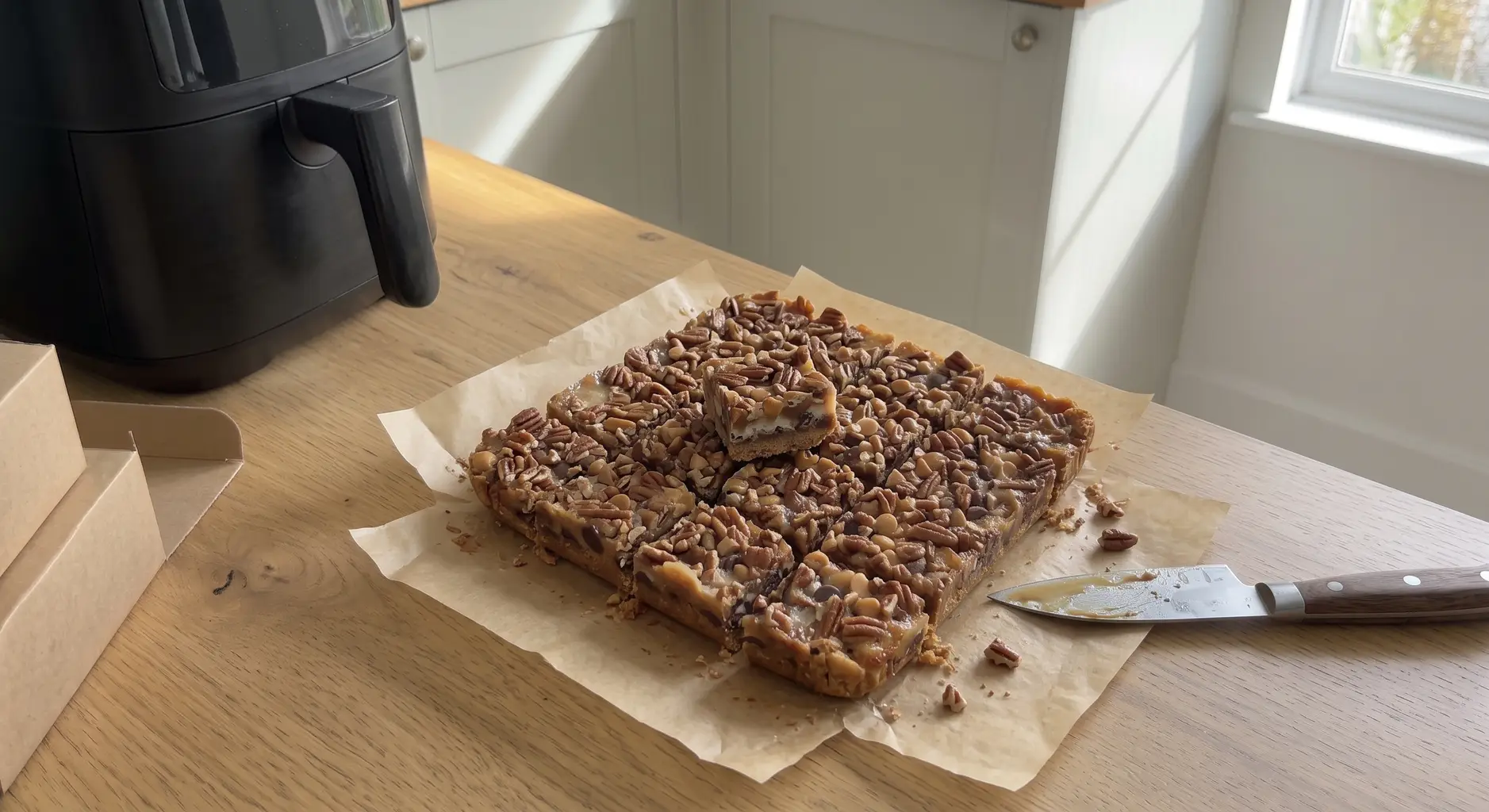
Search for this recipe and you will find a curious silence. Magic bars, seven layer bars, Hello Dollies, whatever your family called them, are one of the most-baked desserts in America, and every published version assumes a 9x13 pan and a full-size oven. The air fryer results are a Facebook group post and a TikTok discovery page. Nobody has written the actual recipe, and once you try it, you understand why: the first attempt at oven settings comes out with blackened coconut over milk that never set, and most people reasonably stop there.
The fix is not a smaller version of the oven recipe. It is a reordering of the layers, plus a temperature that respects what condensed milk and sweetened coconut actually are, which is sugar in its two most flammable formats.
Quick answer: Build the bars in a parchment-lined 7-inch pan with the coconut buried under the condensed milk instead of on top, and the pecans in the exposed top spot. Bake at 300°F for 22 to 26 minutes, tenting foil over the pan once the pecans turn deep golden, usually around minute 15. Done is visual: the condensed milk bubbling slow and caramel-gold at the edges. Then the hard part, which is a 2 hour cool plus 30 minutes in the fridge before cutting. Oven recipes say 350°F with coconut on top; in a basket that combination is a fire drill.
The most burn-prone bake in the basket
Ranking the things this site has baked by how eagerly they burn, magic bars take the top spot without much competition, and it is worth understanding why before you preheat anything.
- Sweetened shredded coconut is kindling. Each strand is thin, dry at the surface, coated in sugar, and full of oil. In an oven at 350°F, coconut on top of these bars toasts unevenly and the corners routinely go past brown. In a basket, where the element sits inches away and moving air strips off the layer of cooler air that would otherwise slow things down, exposed sweetened coconut can go from white to burnt in under four minutes.
- Sweetened condensed milk is pre-loaded caramel. It is milk with more than half its weight in sugar, which means it browns beautifully at the edges and scorches with enthusiasm anywhere the heat concentrates. You want the edge caramelization. You do not want it on the entire surface.
- The bake cannot be rushed. The condensed milk needs time to thicken and bind all seven layers, which means the top sits under that element for 20-plus minutes. A blondie can sprint. This bake has to walk through the hottest part of the machine slowly.
Two of those three problems are solved by architecture rather than temperature, which is the next section. The third is solved by 300°F, the lowest setting this site uses for any bar. Our blondies and brownies run at 320°F; magic bars give up those 20 degrees because their surface is sugar in a way a batter never is. If top-browning chases you across other bakes too, how to prevent burning covers the whole family of fixes.
The layer order is the recipe
Every oven version of this recipe stacks the layers in roughly the order the 1960s can label suggested, and the details vary because the order barely matters in an oven. In a basket the order is the difference between success and charcoal, so here it is, bottom to top, with the reasoning attached:
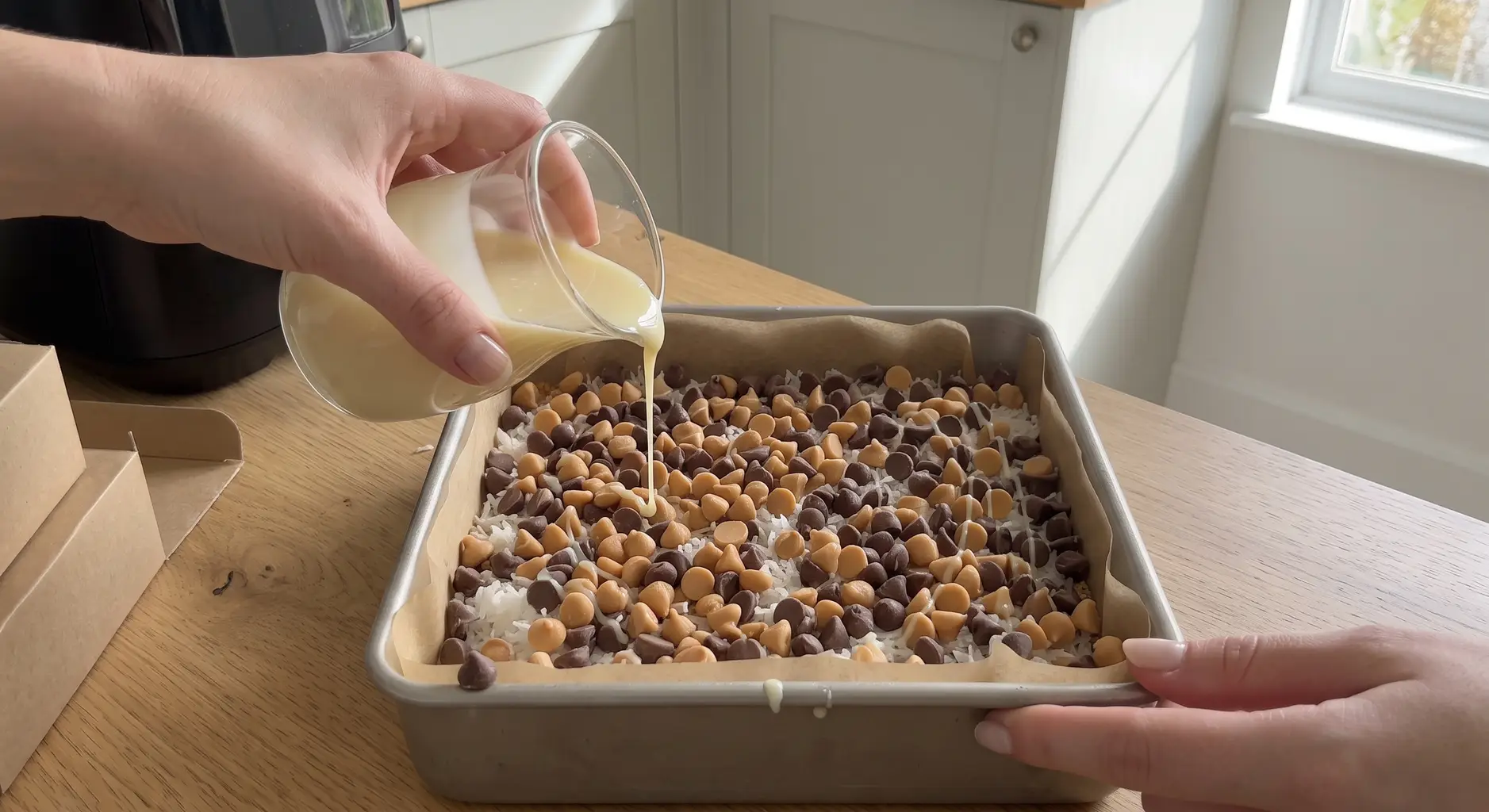
Butter and graham crumbs
Melted butter stirred into crumbs and pressed flat. The crust bakes protected at the bottom of the stack, exactly where a basket is gentlest.
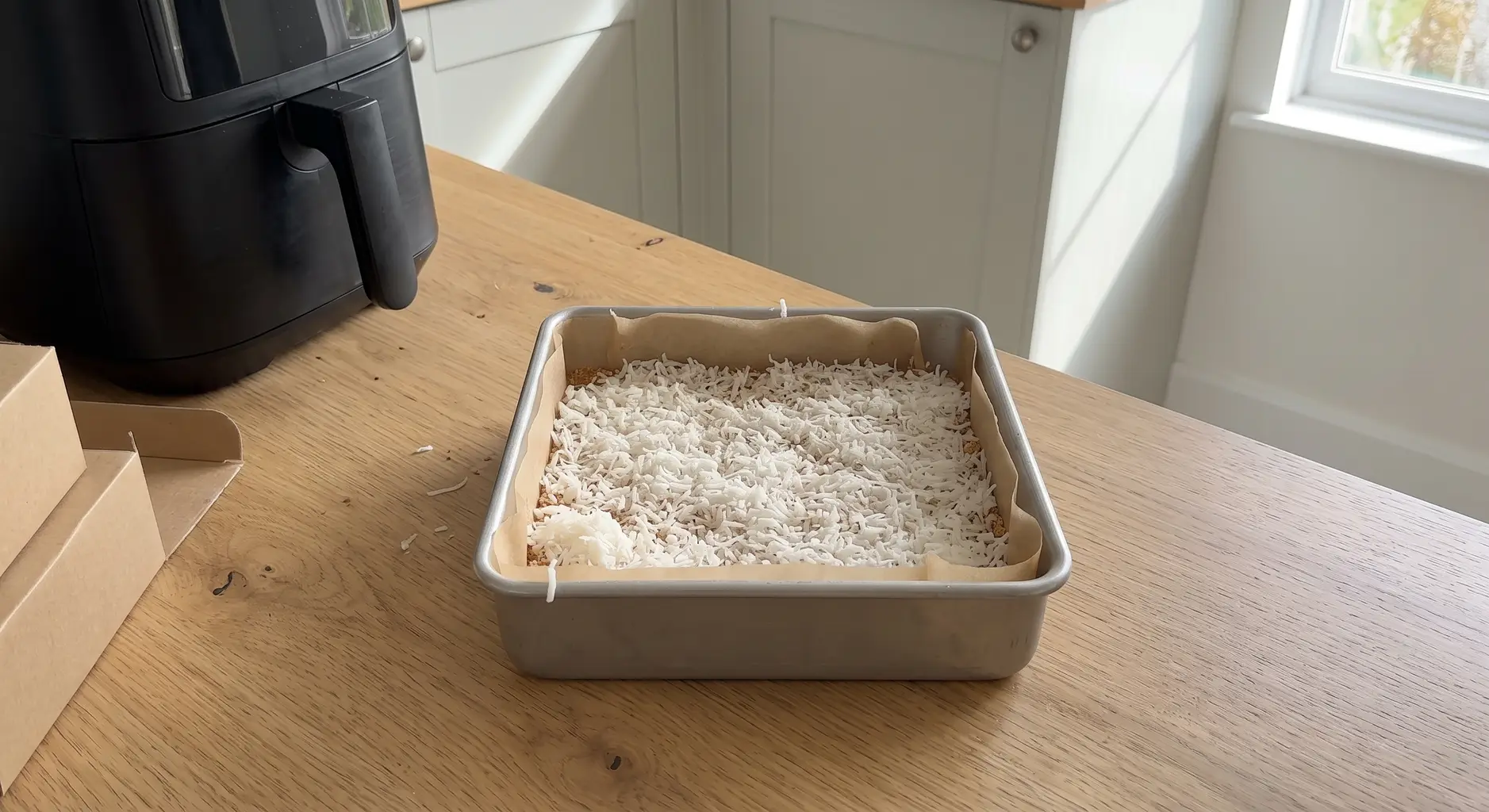
Coconut, moved down
The big change. Oven recipes put coconut on top to toast. Here it goes directly on the crust, where the condensed milk will soak it into chewy, macaroon-like safety.
Chocolate, then butterscotch
Both chip layers sit mid-stack, shielded from direct heat so they soften and fuse instead of scorching dry on top.
Condensed milk, poured slow
Drizzled over everything in thin ribbons so it seeps down through the chips and into the coconut. This layer is the glue, and coverage is its whole job.
Pecans on top
The one ingredient up there that wants browning and can take it. Toasted pecans are better pecans, so the hot seat is a feature.
The result reads like the classic in every bite, because your teeth do not care about vertical order. What changes is that the ingredient that burns first now cannot burn at all, and the ingredient on top is the only one improved by the position. If you have made our thumbprint cookies, this is the same logic that keeps the jam from boiling over, applied to a whole pan.
The coconut question
Sweetened or unsweetened matters more here than in any other bake on this site, and the answer depends on the layer order you use.
| Coconut | On top (oven style) | Under the milk (this recipe) |
|---|---|---|
| Sweetened shredded | Burns fast in a basket. Avoid | Ideal. The sugar dissolves into the milk and the strands stay chewy |
| Unsweetened shredded | Tolerates a few more minutes, still risky | Works, slightly less rich, drinks up more milk |
| Large flakes | The worst option, thin edges char first | Fine, but they clump; shredded distributes better |
This recipe uses sweetened shredded coconut, the classic, precisely because burying it removes the only reason to avoid it. If you want visible toasted coconut for looks, toast a spoonful separately in the basket for 2 to 3 minutes at 300°F, watching the entire time, and scatter it over the finished bars after they cool. If coconut is the reason you are here rather than a passenger, the coconut macaroons give it the lead role.
What done looks like
Unlike our blondies, where doneness is a thermometer number, magic bars are judged by eye, because a probe pushed through seven layers tells you about whichever layer it happens to be sitting in. Fortunately the visual cue here is unambiguous:
- The edges are the clock. Done is when the condensed milk at the rim of the pan bubbles slowly and thickly, like caramel rather than like boiling water, and has turned a deep golden brown. Thin, fast, watery bubbling means it needs more time.
- The center should be set but soft. Nudge the pan: the middle can shimmer slightly, but it should not slosh. It firms substantially as it cools.
- The pecans should be deep golden, which they will reach before the milk is done. That is what the foil tent is for: it stops the top clock while the edge clock keeps running.
The tent is part of the recipe, not a rescue. Around minute 14 to 16, the pecans will hit the right color with 8 or more minutes still to go. Lay a piece of foil loosely over the pan, pressed at the rim so the fan cannot lift it. Whether foil belongs in your particular machine, and how to keep it from flying into the element, is covered in foil or parchment in an air fryer.
Ingredients
One 7-inch pan, sixteen small rich bars. Everything is pantry-stable, and the only measuring subtlety is the condensed milk, which is half a standard can.
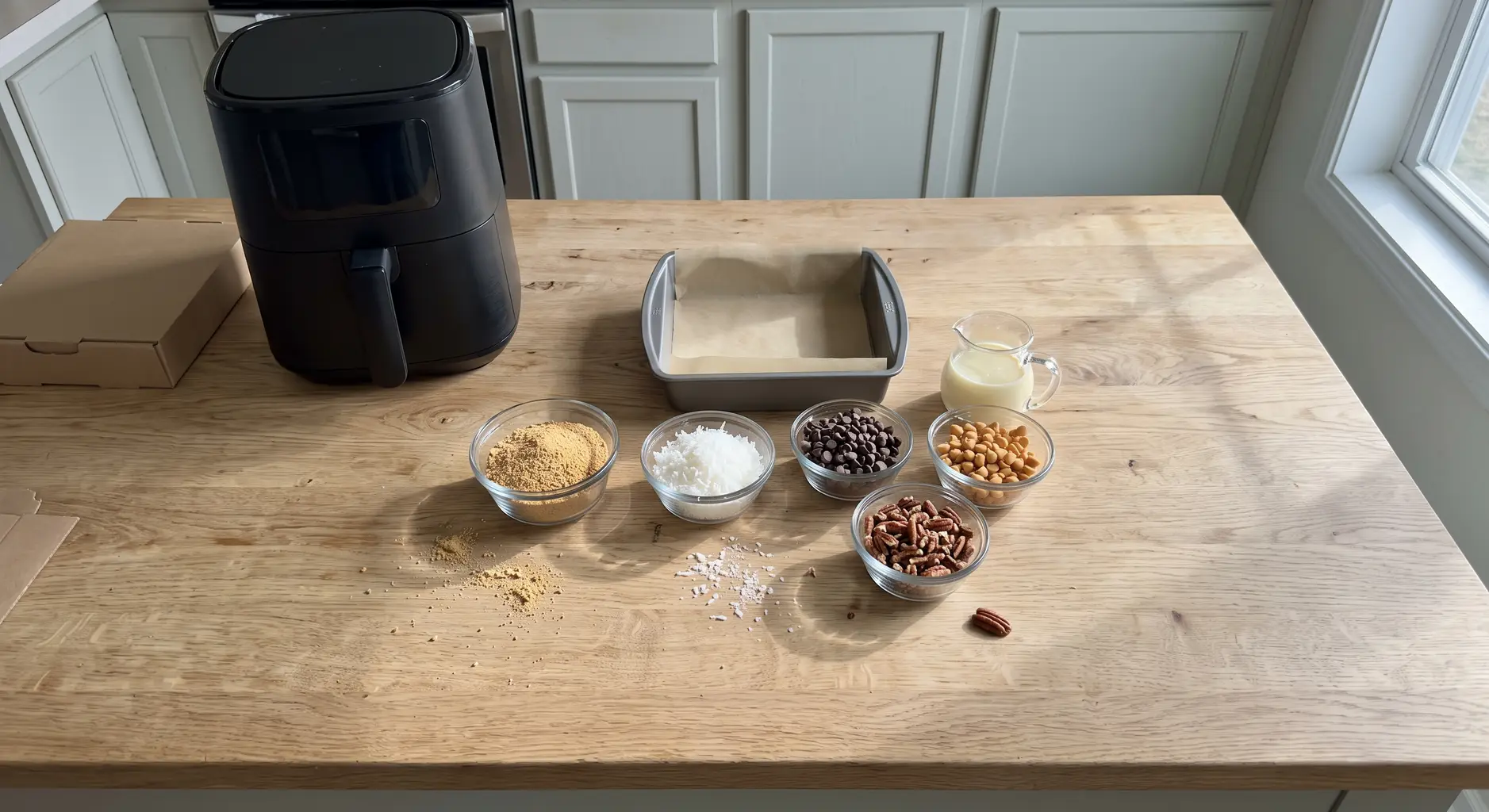
- 1 cup (100g) graham cracker crumbs, about 7 full sheets
- 5 tablespoons (70g) unsalted butter, melted
- 1/8 teaspoon salt
- 3/4 cup (60g) sweetened shredded coconut
- 2/3 cup (120g) semisweet chocolate chips
- 1/2 cup (85g) butterscotch chips
- 7 ounces (2/3 cup) sweetened condensed milk, half a 14-ounce can
- 1/2 cup (55g) chopped pecans
- Optional: a pinch of flaky salt over the top
The chip split is the classic chocolate-plus-butterscotch, and it is the butterscotch that makes these taste like the church potluck version, so resist the urge to go all chocolate on the first bake. Walnuts substitute for pecans one to one. The condensed milk must be sweetened condensed milk, not evaporated milk; evaporated milk has no sugar, will not thicken into glue, and produces a pan of loose, disappointed ingredients.
How to make them
- Line the pan. A parchment sling overhanging two sides of a 7-inch square or round pan, and a light grease on the exposed walls. These bars are glue by design; the sling is not optional.
- Preheat to 300°F (150°C) for 3 minutes. Low is the point, and this is the lowest bar temperature on this site. When preheating matters covers the bakes where you can skip it.
- Make the crust. Stir the melted butter and salt into the graham crumbs until the texture is wet sand, press the mixture flat and firm into the pan with the base of a measuring cup, and run it slightly up the corners.
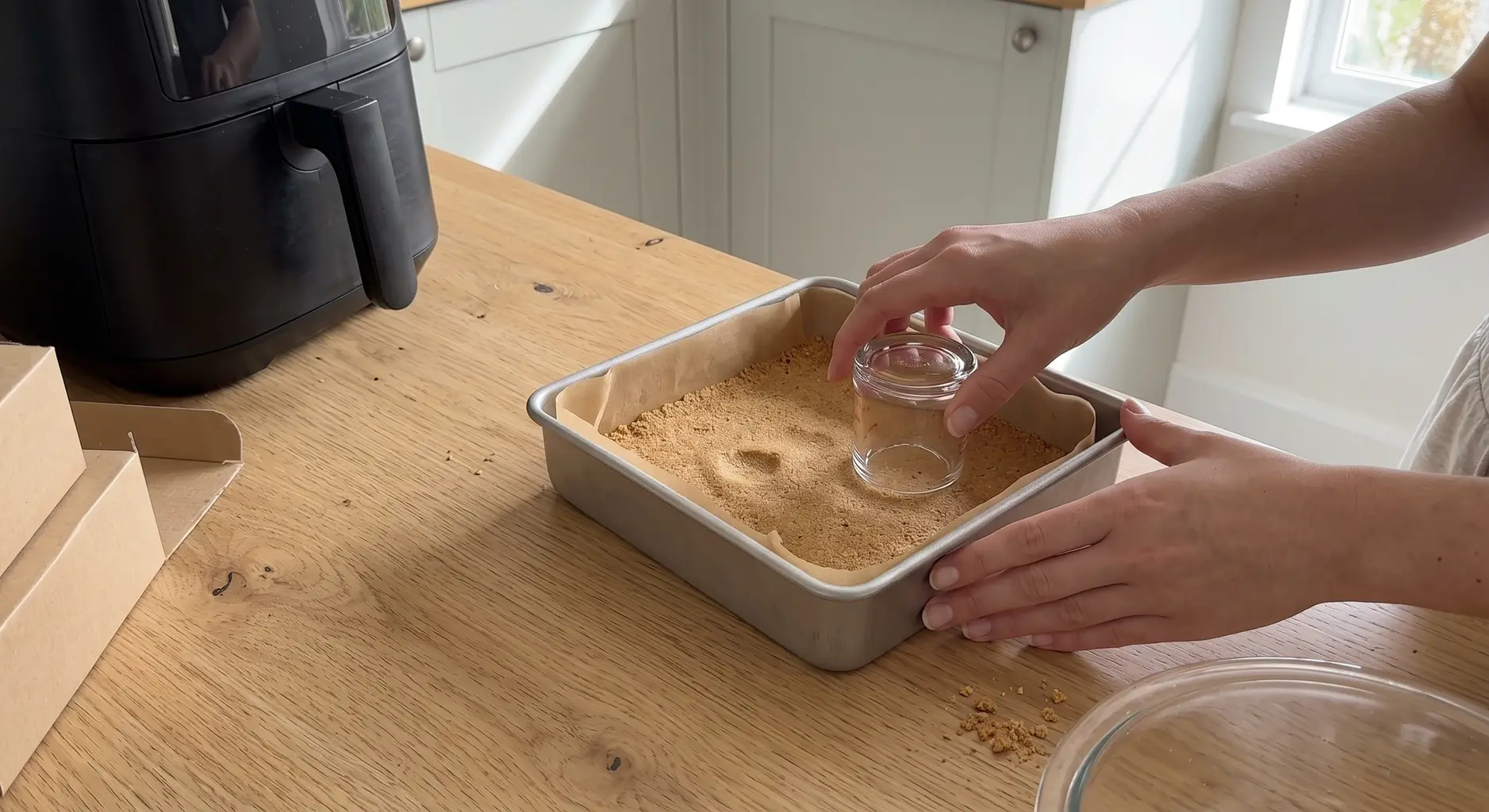
Wet sand, pressed firm with a flat glass. A loose crust crumbles the moment the knife arrives. - Scatter the coconut evenly over the crust. Bottom of the stack, on purpose. This is the layer that burns on top and cannot burn down here.
- Layer the chocolate chips, then the butterscotch chips over the coconut, edge to edge. Even coverage matters more than neatness.
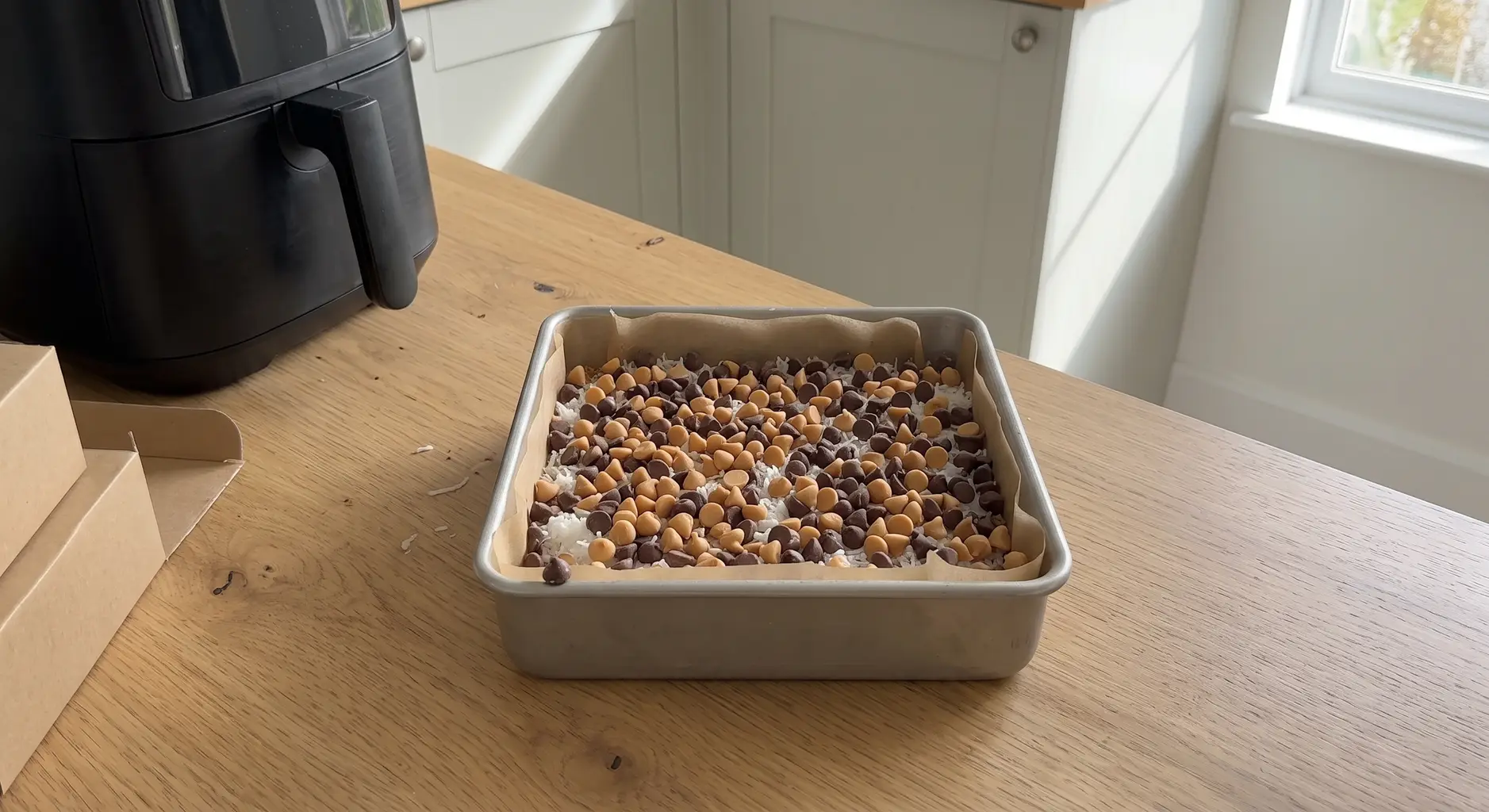
Both chips, edge to edge. Bare patches here become bare patches in the finished bar. - Pour the condensed milk over everything in slow, thin ribbons, working from the edges inward, until the surface is covered. It will seep down through the chips into the coconut, which is its job. Do not stir.
- Scatter the pecans over the top and press them in gently with a flat hand so the milk grips them. Add the flaky salt now if using.
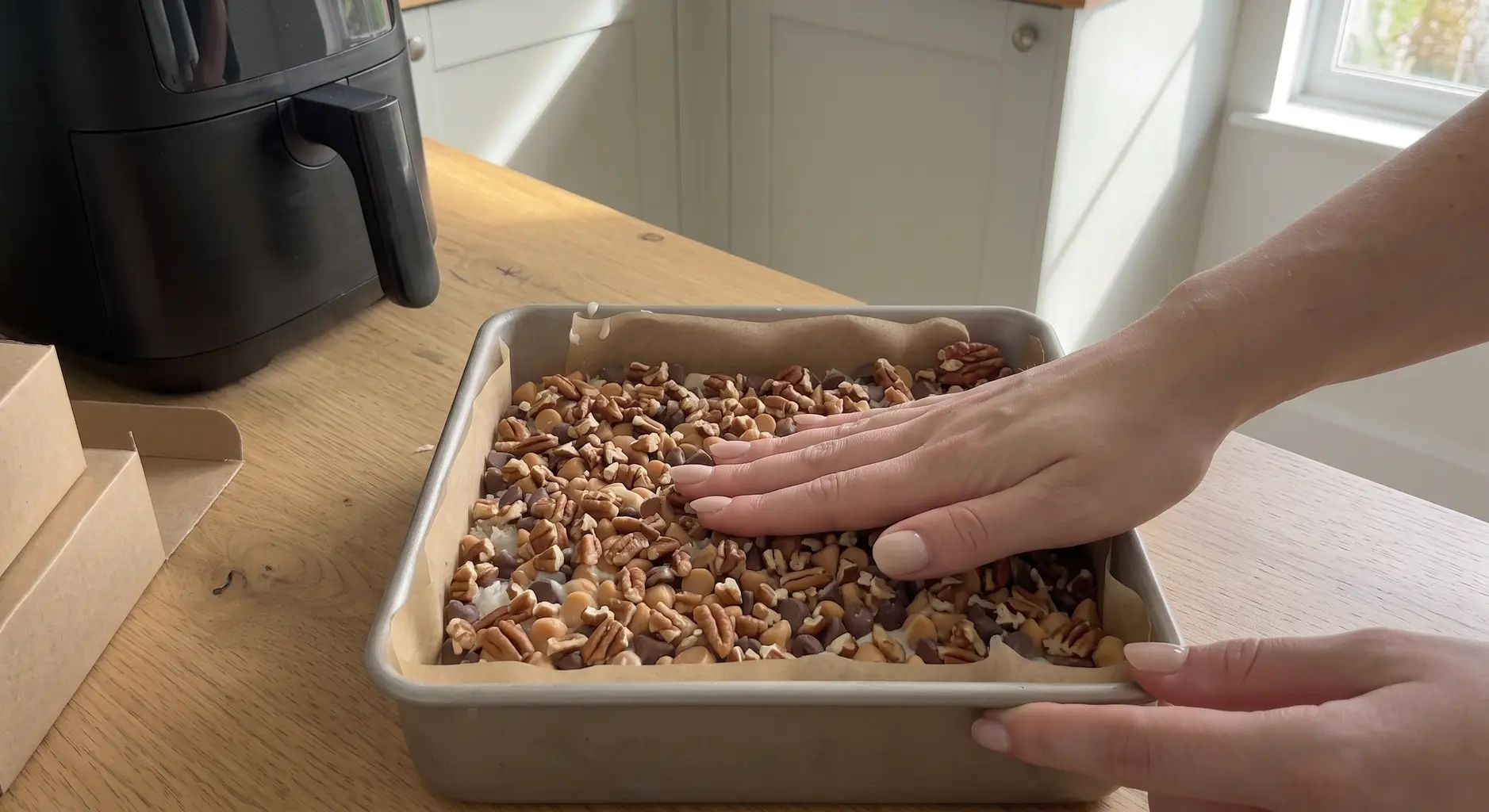
Press the pecans in with a flat hand so the milk grips them. Loose nuts roll off the first square you cut. - Bake 22 to 26 minutes at 300°F. No peeking for the first 12 minutes.
- Tent at deep golden, usually minute 14 to 16. When the pecans and the milk between them reach a deep golden brown, lay foil loosely over the pan, pressed down at the rim so the fan cannot move it.
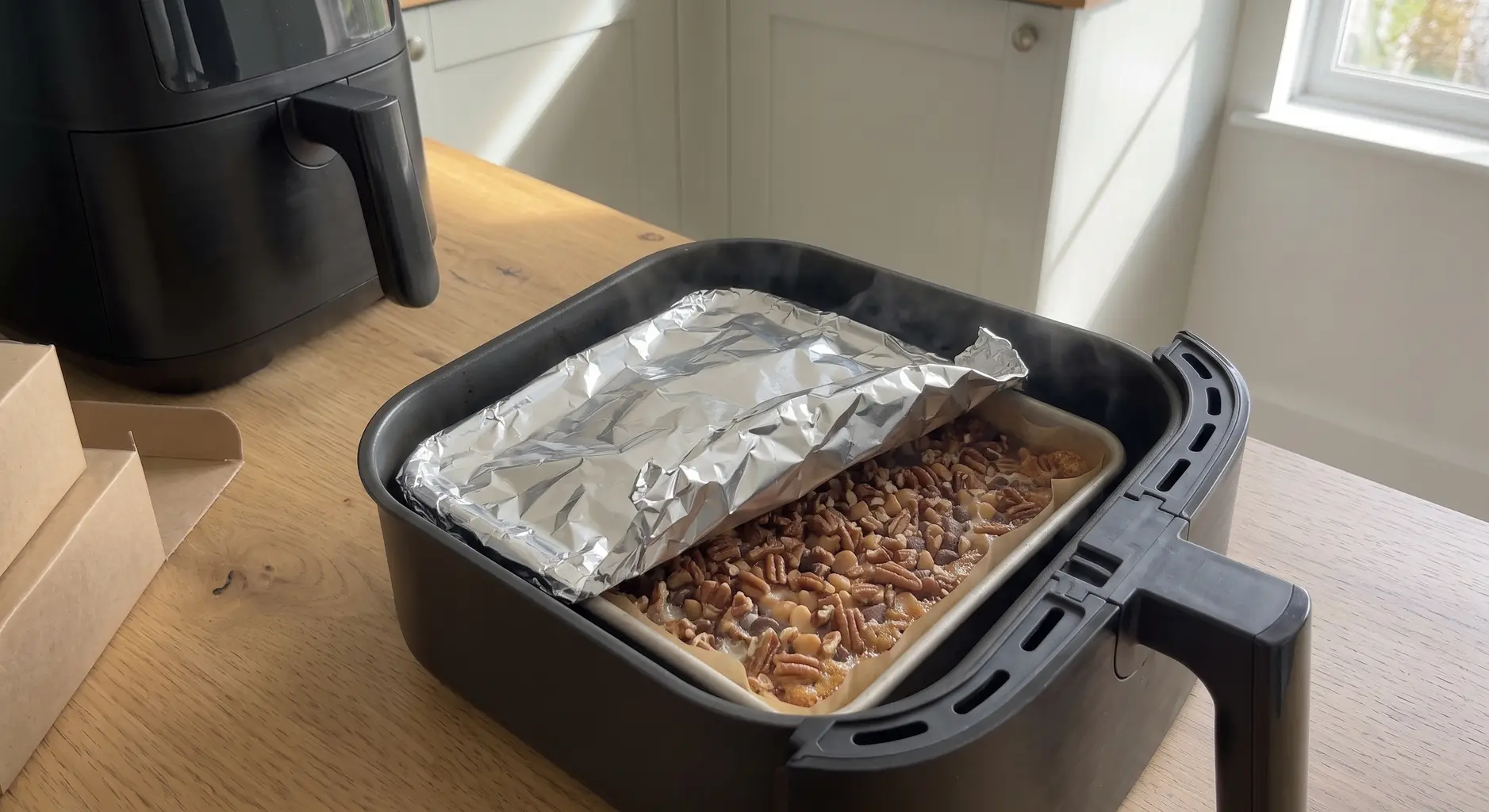
Foil goes on when the pecans turn deep gold, pressed down at the rim so the fan cannot lift it into the element. - Judge by the edges. Done is condensed milk bubbling slow, thick and caramel-gold at the rim, with a center that shimmers but does not slosh. If the edges still bubble thin and fast at 26 minutes, give it 2 more with the tent on.
- Cool 2 hours in the pan, then 30 minutes in the fridge. The milk is molten glue straight out of the basket and structural caramel once cool. Cutting early is how bars become a topping.
- Lift out with the sling and cut into 16 squares with a large knife run under hot water and wiped dry between cuts. Cold bars plus a hot dry blade is the whole secret to clean layers.
Why 300°F when oven recipes say 350. A basket cooks a real 25 to 30 degrees harder at the same dial number, because the element is close and the moving air strips away the insulating layer that still oven air provides. The air fryer calculator applies that standard drop automatically and would hand you 325°F for this bake; we go a step further to 300°F because the exposed surface here is condensed milk and nuts rather than batter, and sugar punishes optimism. The reasoning behind the standard conversion lives in the conversion guide, and the site-wide settings table is on the baking chart.
Pan size and the half-can question
| Pan | Batter | At 300°F | Notes |
|---|---|---|---|
| 7-inch square or round | The recipe as written | 22 to 26 min | Sixteen bars. The default |
| 6-inch square or round | As written, thicker | 26 to 30 min | Deeper, gooier, tent earlier |
| 8-inch square | Scale by 1.3 | 20 to 24 min | Only if your basket truly fits it with airflow around the rim |
| 9x13 in the oven | Double everything, whole can | 350°F, 25 to 30 min | The potluck batch. The basket version is not for feeding forty |
The pan size calculator tells you what your basket actually takes if you have never measured it, and the recipe scaler resizes the quantities for whichever pan you land on.
Now the half can, because it is the one honest annoyance in this recipe. A standard can of sweetened condensed milk is 14 ounces and this bake uses 7, and no, using the whole can does not make the bars twice as good; it makes them a pan of sweet soup that never sets in a 7-inch footprint. The leftover half keeps in a jar in the fridge for about 2 weeks, and it is one of the most useful sweet ingredients you can have sitting there: drizzle it over apple fries as a dipping sauce, stir it into iced coffee, or accept the obvious conclusion, which is that a second batch of these was always going to happen.
Fixing what goes wrong
| What you got | Why | Fix |
|---|---|---|
| Burnt coconut or black-edged nuts | Oven layer order, oven temperature, or no tent. | Coconut under the milk, 300°F, foil at deep golden. All three are the recipe. |
| Bars fell apart into layers | Milk never covered the surface, or the bake stopped before the edges caramelized. | Pour in ribbons to full coverage, and bake until the edge bubbles turn slow and thick. |
| Gooey puddle instead of bars | Cut warm. The milk sets on the counter, not in the basket. | 2 hours plus 30 fridge minutes. Set a timer and leave the kitchen. |
| Rock-hard, toffee-like bars | Overbaked past caramel into candy, usually chasing a firmer center. | The center is supposed to shimmer at the end. Pull on the edge cue. |
| Soggy, greasy crust | Crust pressed too loose, or the butter pooled. | Press hard with a flat-bottomed cup, and measure the butter rather than eyeballing. |
| Ragged, smeared cuts | Room-temperature bars and a cold dry knife. | Fridge-cold bars, hot knife, wiped between every cut. |
| Foil blew into the element | Laid on loose in a strong fan. | Press it at the rim, or weight the corners with a few pie weights. |
If a failure here does not match its row, the troubleshooting guide works symptom-first across every bake on the site.
Variations
- The purist swap. All chocolate chips, no butterscotch. Legitimate, and closer to the Eagle Brand original, though you lose the flavor that makes strangers ask for the recipe.
- Peanut butter chips in place of butterscotch, with the pecans swapped for roasted peanuts. This one disappears fastest in our house.
- Salted dark. Dark chocolate chips, the flaky salt made mandatory, and a slightly less sweet bar that adults hover over.
- Gluten-free is a crust decision only: gluten-free graham-style crumbs swap one to one, and every other layer is already flourless.
- White chocolate and cranberry for December: white chips in place of butterscotch, a handful of dried cranberries scattered with the coconut, and the same bake.
- No coconut at all is answerable: double the pecans and add them to the mid-stack. The bars lose their chew and a layer, and become something closer to a gooey blondie with a crust. At that point, consider just making the blondies.
Magic bars sit in the middle of a shelf that is worth knowing. Cheesecake bars solve the same 7-inch pan a completely different way, with a custard instead of a caramel; brookies stack two doughs in one tin the way this one stacks seven layers; and lemon bars share the two-stage build, base first and filling poured on after. The whole set lives in the cookies and bars collection.
If bars and cookies are your genre, monster cookies are the same everything-in kitchen-sink spirit in cookie form, chocolate chip cookies run 8 minutes for the impatient, and brownies are the fudgy sibling with a thermometer number instead of a bubble cue. The full method behind everything is how to bake in an air fryer.
Storage and freezing
- Room temperature: 5 days airtight, with parchment between stacked layers, because these bars will otherwise reunite into one large bar. Day two is the peak, once the caramelized milk has fully settled into chew.
- Refrigerated: up to a week, and the cold version is its own dessert, denser and closer to candy. Some households split the batch deliberately.
- Frozen: 3 months, wrapped individually. Thaw an hour on the counter, or eat one half-frozen, which is not a serving suggestion so much as a report from the field.
- Reviving a day-old bar: 90 seconds at 300°F in the basket brings the edges back and softens the milk to just-baked. Watch it; you already know what the top layer thinks of heat.
Twenty-five minutes of basket time against heating a full oven for one small pan is exactly the math this machine wins, and the running cost calculator will put your own electricity rate on it. All four air fryer tools live in one place, the guides index covers the technique behind every number here, and the full recipe index has everything else.
Frequently asked questions
QCan you make magic bars in an air fryer?
Yes, with one structural change: the coconut moves from the top of the stack to directly on the crust, under the condensed milk, and the pecans take the top spot. Exposed sweetened coconut cannot survive a basket's close element, but buried coconut cannot burn at all. Bake at 300F for 22 to 26 minutes in a 7-inch pan, tent with foil once the pecans turn deep golden, and pull when the condensed milk bubbles slow and caramel-gold at the edges.
QWhat temperature and how long for air fryer magic bars?
300F for 22 to 26 minutes in a 7-inch pan, with a loose foil tent added once the top reaches deep golden, usually around minute 14 to 16. That is the lowest bar temperature on this site, a full 50 degrees under the oven standard of 350F, because a basket cooks 25 to 30 degrees harder at the same setting and the exposed surface here is condensed milk and nuts, which scorch earlier than any batter. Judge doneness by the edges: slow, thick, caramel-colored bubbling.
QHow do I keep the coconut from burning in the air fryer?
Move it. This recipe puts the coconut on the crust, beneath the chips and the condensed milk, instead of scattered on top the way oven recipes do. The milk soaks it into a chewy, macaroon-like layer that physically cannot scorch, no matter what the element does. The pecans take the exposed top position because toasting improves nuts and ruins coconut. If you want toasted coconut for looks, toast a spoonful separately at 300F for 2 to 3 minutes, watching constantly, and scatter it on after cooling.
QHow do I know when magic bars are done?
Watch the edges, not the clock and not the center. Done is when the condensed milk at the rim of the pan bubbles slowly and thickly, like caramel rather than boiling water, and has turned deep golden brown. The center should shimmer slightly when you nudge the pan but not slosh; it firms as it cools. A thermometer is no help here because a probe through seven layers only reports on whichever layer it lands in. Thin, fast, watery bubbling at the edge means more time under the tent.
QCan I use evaporated milk instead of sweetened condensed milk?
No, and this is the one substitution that fails completely rather than partially. Sweetened condensed milk is more than half sugar, and that sugar is what thickens into the caramel glue that binds seven loose layers into a bar. Evaporated milk is just concentrated milk with no sugar: it will not thicken, will not brown into structure, and leaves you a pan of warm ingredients sitting in thin dairy. The cans sit side by side on the shelf and look near-identical, so read twice.
QWhy did my magic bars fall apart when I cut them?
Almost always one of two things. Either they were cut warm, when the condensed milk is still molten glue rather than set caramel, or the milk never fully covered the surface during assembly, leaving dry zones with nothing binding them. The fixes: pour the milk in slow thin ribbons until the coverage is complete, bake until the edge bubbling turns slow and thick, then cool a full 2 hours on the counter plus 30 minutes in the fridge. Cut cold with a hot, dry knife, wiped between cuts.
QCan I use the whole can of condensed milk?
Not in a 7-inch pan. The recipe uses 7 ounces, half a standard 14-ounce can, and doubling the milk in the same footprint gives you a sweet soup that never sets, because the bake time needed to caramelize that much liquid would incinerate everything above it. The leftover half keeps refrigerated in a jar for about 2 weeks and earns its shelf space: dipping sauce for apple fries, a spoonful in iced coffee, or the second batch of these that was statistically always going to happen. For a whole-can batch, double everything into a 9x13 and use the oven at 350F.
QDo I need foil on top, and is it safe in an air fryer?
The tent is part of this recipe, not an emergency measure. The pecans and surface milk reach their ideal color around minute 14 to 16, with 8 or more minutes still needed for the edges to caramelize, and the foil stops the top clock while the edge clock runs. Foil is safe in a basket as long as it cannot reach the element: lay it loosely over the pan and press it firmly at the rim, or weight the corners, so the fan cannot lift it. Never foil an empty basket floor.
QWhat are the seven layers in seven layer bars?
The traditional count: butter, graham cracker crumbs, chocolate chips, butterscotch chips, sweetened shredded coconut, sweetened condensed milk, and chopped pecans. Butter and crumbs merge into one crust, which is why the bars read as five strata in cross-section and why the counting has fueled potluck arguments since the recipe first appeared on can labels in the 1960s. This air fryer version keeps all seven; it only changes their vertical order, with the coconut moved under the milk and the pecans on top.
QCan I double this recipe in the air fryer?
Not in one pan. Doubled layers in the same footprint means the condensed milk sits twice as deep, and the edge caramelization that signals doneness would arrive long before the middle sets. Bake two batches back to back instead; the second runs a minute or two faster in a heat-soaked machine, and each batch is only 25 minutes. If your basket genuinely fits an 8-inch square with airflow around the rim, the recipe scales by about 1.3 at the same temperature. The honest big-batch answer is a 9x13 in the oven.
QHow should I store magic bars?
Airtight at room temperature for 5 days, with parchment between stacked layers, since the caramelized milk will otherwise glue the bars back into a slab. They are at their best on day two. Refrigerated they last a week and turn denser and candy-like, which some people prefer outright. Frozen, individually wrapped, they keep 3 months and thaw in an hour on the counter. A 90-second revival at 300F in the basket brings a day-old bar back to gooey, watched closely, because the top layer's opinion of heat has not changed.
QAre magic bars the same as seven layer bars and Hello Dolly bars?
Same bar, three names, and which one you use mostly reveals where your family got the recipe. Magic cookie bars is the Eagle Brand can-label name, seven layer bars counts the ingredients, and Hello Dollies traces to a 1960s community-cookbook recipe named, by most accounts, during the Broadway run of Hello, Dolly. The formula is identical: graham crust, chips, coconut, nuts, condensed milk. Whatever your grandmother called them, the air fryer adjustments on this page apply unchanged.