
Air Fryer English Muffins: Nooks and Crannies, No Griddle
Half of what ranks for this recipe is instructions for toasting a store-bought muffin, and the other half rolls out a firm dough, cuts neat rounds, and wonders in print why the crumb came out even and tight. The nooks and crannies are not a brand secret. They are air bubbles in a wet dough that nobody flattened, torn open with a fork instead of sheared with a knife. This page builds that dough, replaces the griddle with the one thing a basket does that mimics it, and runs cooler than any recipe you will find, 300°F, because an English muffin is supposed to come out pale gold and flat, not browned and puffed like a dinner roll.
What’s on this page
- What the griddle does, and what replaces it
- Where nooks and crannies come from
- The one bake where the flip belongs
- Fork-split, never knife
- Temperature and timing
- What done looks like
- Ingredients
- How to make them
- Fixing what goes wrong
- Toasting them, and store-bought ones
- Serving, storage, leftovers
- Frequently asked questions
What the griddle does, and what replaces it
English muffins are not baked. In a bakery they are cooked on a griddle, and the griddle is responsible for everything you recognize about them: the flat top and bottom, seared pale gold by direct contact with hot metal, the soft white sides that never touch anything, and a gentle cook-through that leaves the crust thin and the interior moist. An oven cannot make one look right, which is why oven recipes for English muffins barely exist.
A basket air fryer, oddly, can get closer than an oven, because it has one griddle-like trick available: contact through the floor. A muffin sitting on parchment cooks its underside flat and pale by conduction, exactly the way a griddle face does. The problem is that a griddle does both faces, one at a time, and a basket only does the bottom. The replacement is obvious once you say it out loud: cook one face down, then turn the muffin over and cook the other. One flip, halfway through, and both faces get their griddle moment while the sides stay soft and white.
The other half of the impersonation is restraint on temperature, which gets its own section below, because it is where every from-scratch air fryer version goes wrong.
Where nooks and crannies come from
The trademarked slogan has convinced people the texture is a factory secret. It is not. Nooks and crannies are ordinary fermentation bubbles in an unusually wet dough, preserved because nobody crushed them, and revealed because the muffin was torn rather than cut.
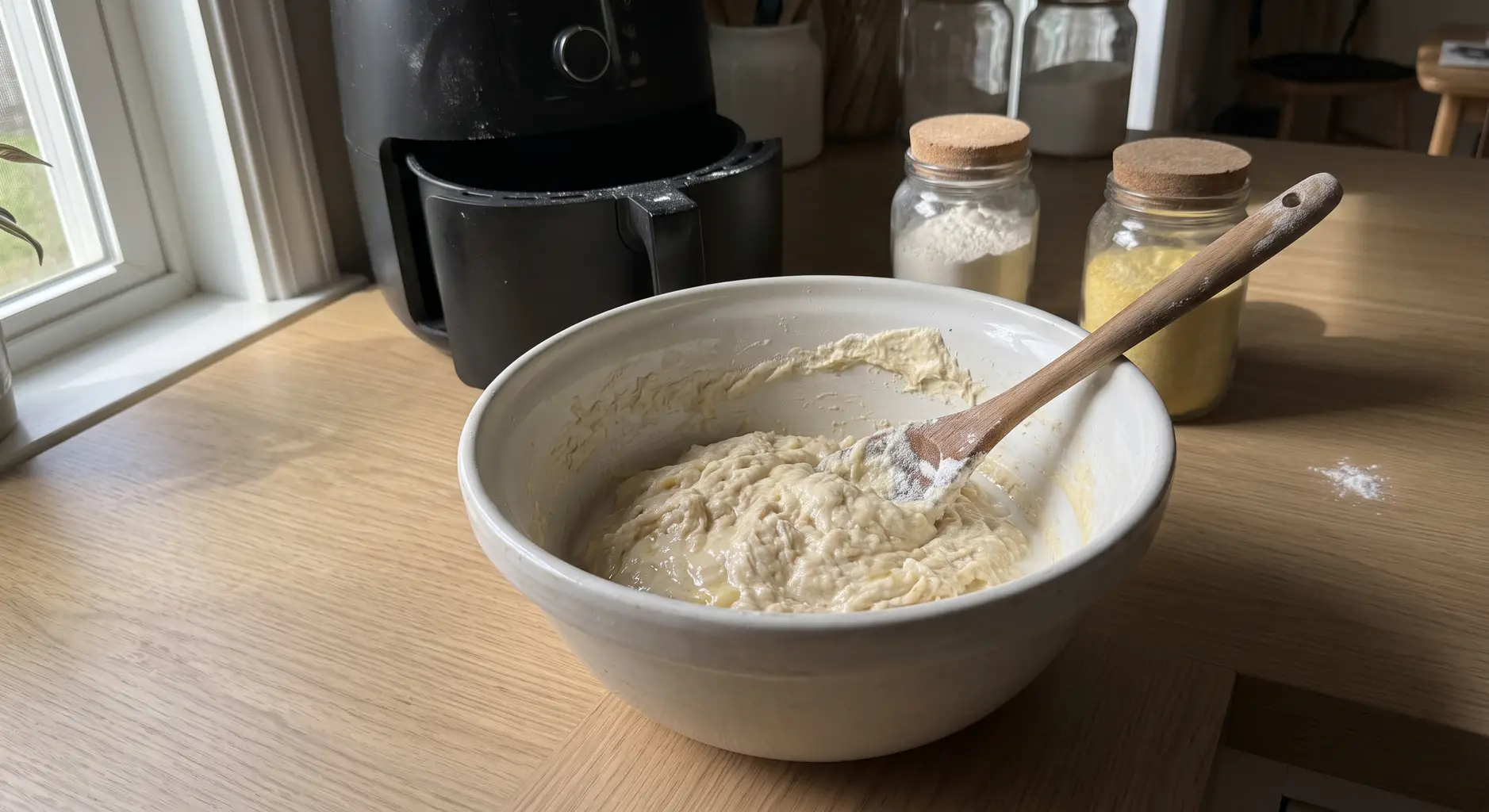
That sentence contains the two mistakes that flatten every tight-crumbed homemade attempt. The first is a dry dough: a standard 60 percent hydration bread dough is too stiff to hold big irregular bubbles, so it ferments into an even, fine crumb no matter what you do afterward. This dough runs wetter, at about 72 percent hydration, slack and sticky and stirred together with no kneading at all, close kin to the wet-dough approach our bread methods lean on, and the same principle the no-knead loaf is built on. Time builds the gluten; the wetness makes room for the holes.
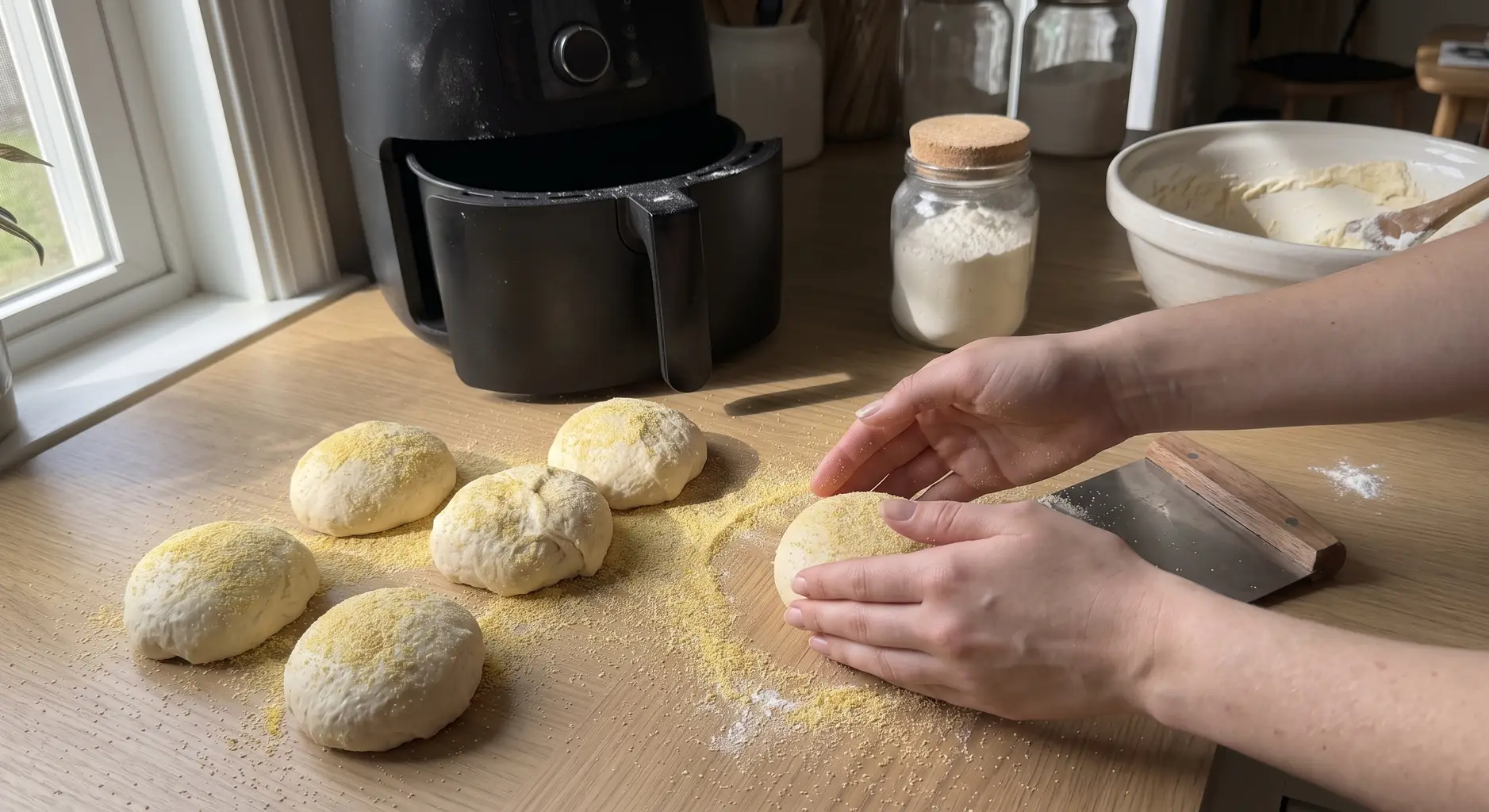
The second mistake is the rolling pin. Roll the dough flat and cut neat rounds, as the from-scratch recipes that rank for this do, and you have pressed out the exact bubbles you spent ninety minutes growing. This recipe never rolls anything. The dough is divided with a floured bench scraper and coaxed into rough pucks with floured fingertips, handled like something fragile, because it is. Lopsided muffins with wild interiors beat perfect cylinders with the crumb of sandwich bread, and that is a trade this page makes without apologizing.
The one bake where the flip belongs
Regular readers will notice something unusual in the method: a flip. This site has spent entire pages arguing against flipping, and the arguments hold; a flip destroys dimpled, oiled, or topped surfaces, and most bakes brown fine without one.
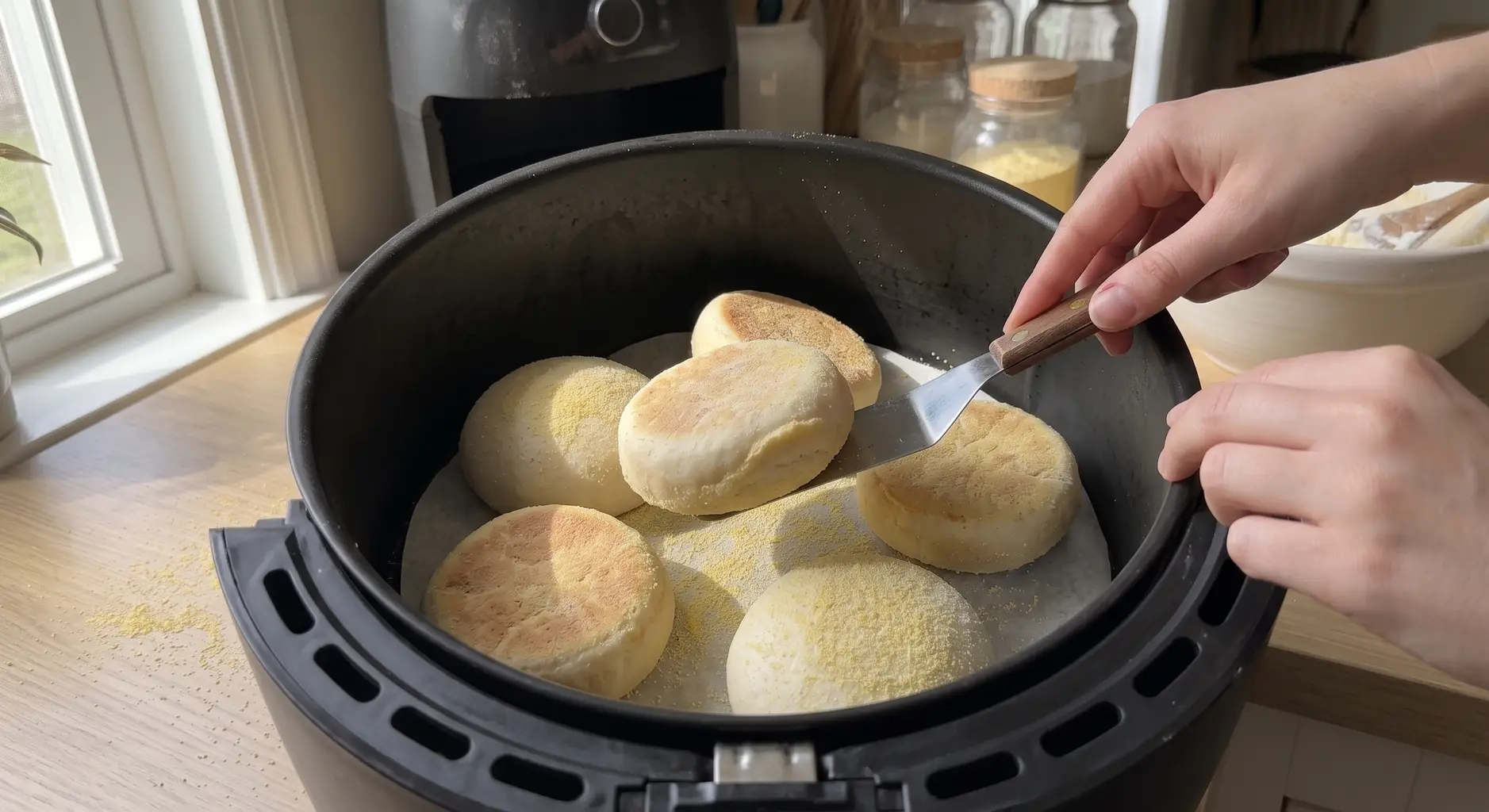
An English muffin is the exception that proves the rule, because here the flip is not a browning patch. It is the griddle impersonation itself. A griddle cooks face one, then face two; the basket cooks the parchment side, then, after the turn, the other. Skip the flip and the top face bakes by moving air instead of contact, and comes out rounded, dry, and roll-like instead of flat and seared. The flip happens at the halfway mark, with a spatula rather than tongs, because a half-cooked wet dough dents if you grab it.
Fork-split, never knife
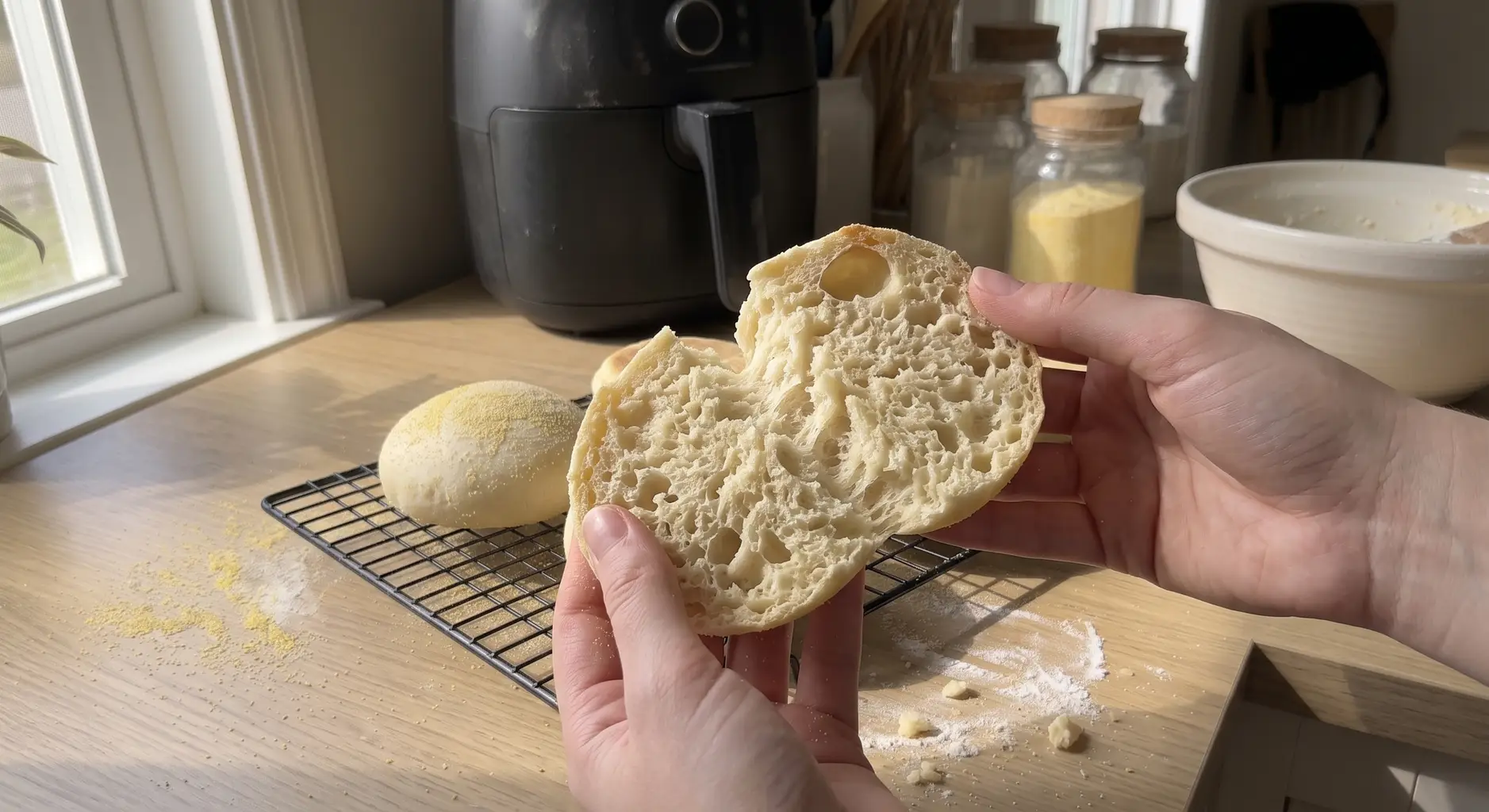
The last place crannies are won or lost is on the cutting board, after the bake is over. A knife shears through the crumb in a flat plane, slicing every bubble wall it meets and leaving two smooth faces that toast evenly and blandly. A fork does something completely different: pushed in around the equator and levered gently, it tears the crumb along its weakest lines, which are the bubble walls themselves. The result is two craggy faces of peaks and pockets, and those ridges are the entire point, because they catch butter in the valleys and crisp at the tips under the broiler or in the basket.
So: fork tines all the way around the waist, then pull the halves apart with your thumbs. It feels slower than a knife for exactly four muffins, and then it becomes the only way you split anything.
Temperature and timing
A bakery griddle runs around 300 to 325°F at the metal, far cooler than an oven, because the goal is a slow cook-through with barely any crust. There is no standard oven temperature to feed our oven-to-air-fryer calculator for this one, and that absence is the tell: this was never an oven food, and the air fryer recipes that borrow bread temperatures end up with bread. The from-scratch versions that rank run 320°F and produce muffins their own authors describe as puffed and lopsided; the toasting posts run 400°F, which is a fine number for toasting and a catastrophic one for raw dough.
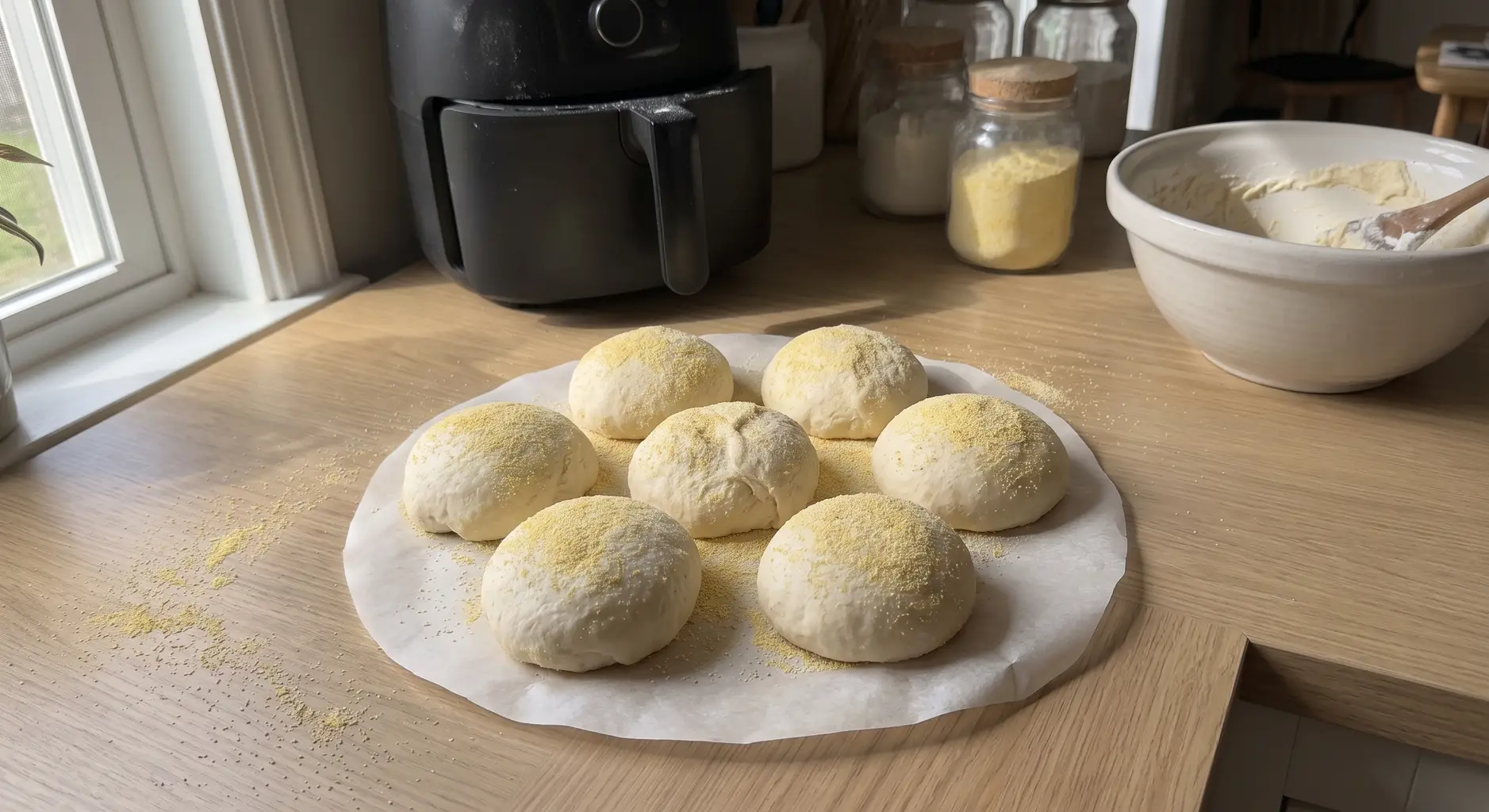
300°F, 7 minutes, flip, 5 to 7 more is the window, the lowest fresh-dough temperature on this site, and it is low on purpose. At 300°F the faces set flat and barely gild, the sides stay white and soft, and the wet interior has thirteen minutes to steam itself into an open crumb instead of six minutes to gasp under a browning crust. Preheat 3 minutes so the parchment side starts searing on contact, the same logic as any preheating decision, and cook on a parchment round per the liner rules. Three muffins per round in a 5 to 6 quart basket; six is two rounds. The full settings library is on the baking chart.
What done looks like
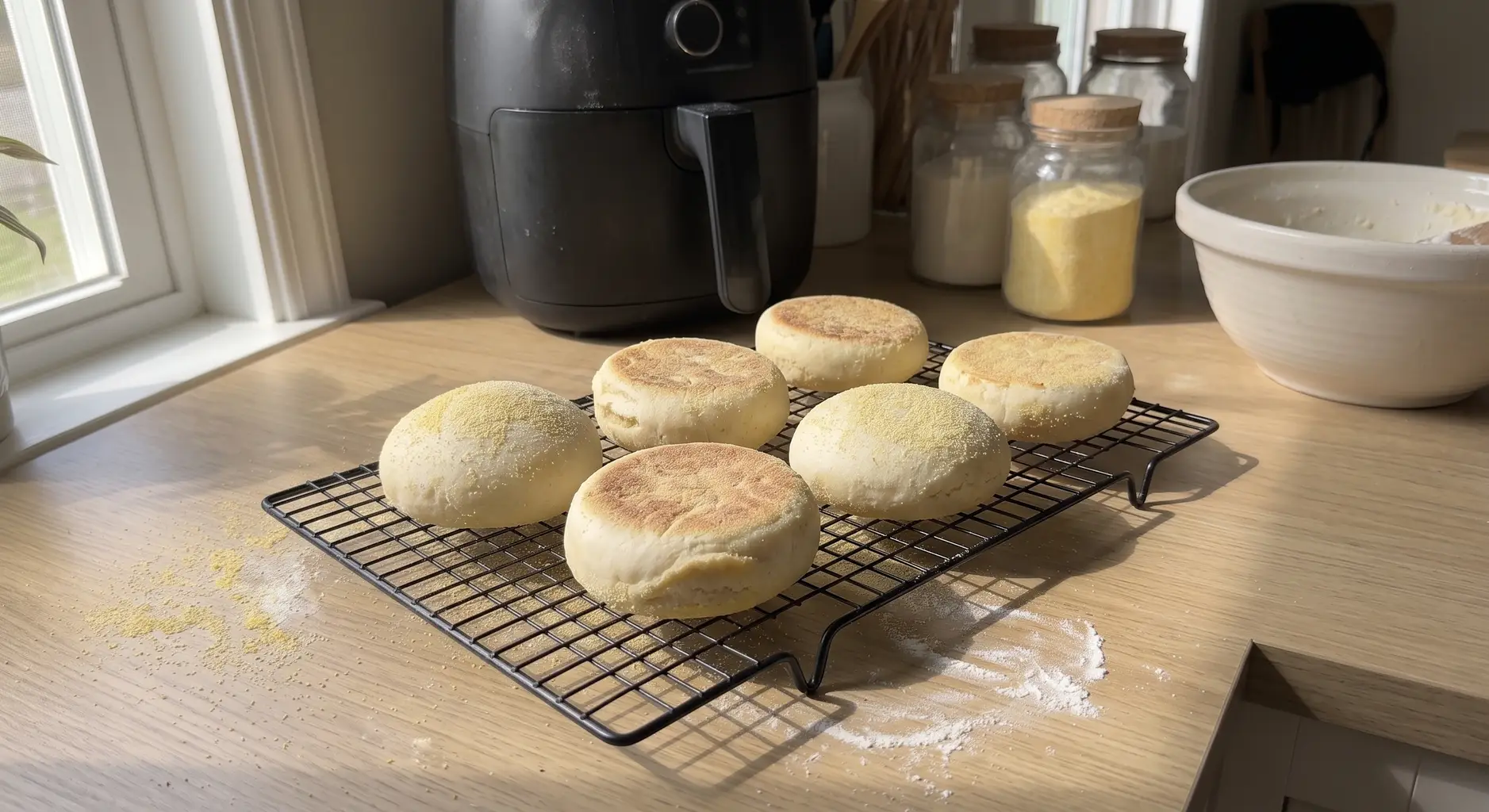
- The faces are matte pale gold, the color of a store muffin, with cornmeal toasted onto them. If they are browning like rolls, the machine is running hot; drop 10 degrees.
- The sides stay soft, white, and slightly springy. Colored sides mean overbaked or overcrowded.
- The center reads 200 to 205°F on an instant-read thermometer through the side. A wet crumb is gummy below 195°F and no amount of surface color will tell you that. No page ranking for this recipe offers a number.
Then rest them 20 minutes before splitting. It is the longest wait on this site relative to the bake, and it is not optional: the interior of a wet-dough muffin finishes setting on the rack, and a fork-split at five minutes gums the exact crumb you built. English muffins are also the rare bread that is genuinely better toasted than fresh, so the patience costs less than it seems.
Ingredients
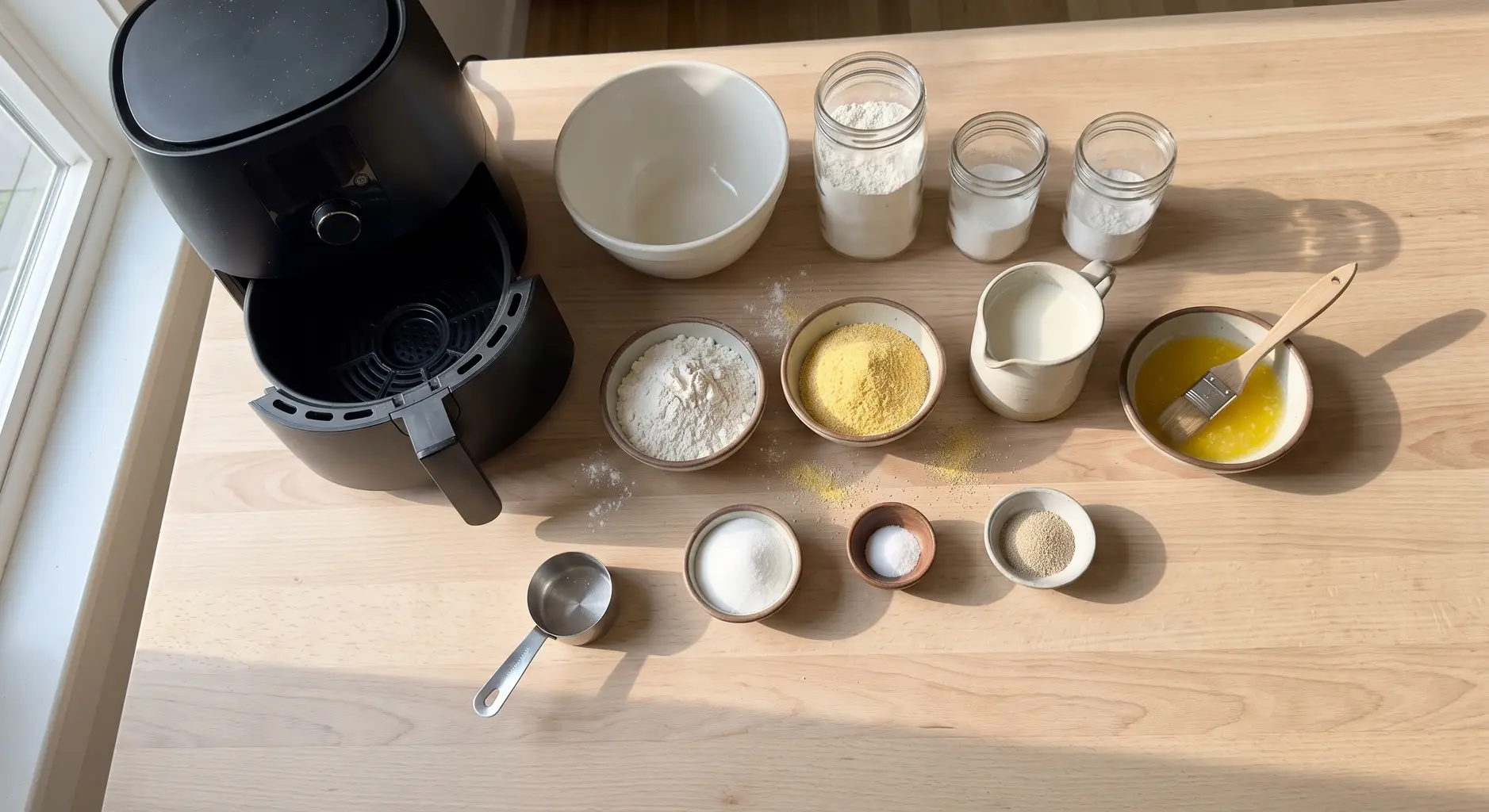
For 6 muffins
- 2 cups (250g) bread flour or all-purpose flour
- ¾ cup (180ml) warm whole milk, about 105°F
- 1 tablespoon unsalted butter, melted
- 1 teaspoon instant yeast
- 1 teaspoon sugar
- ¾ teaspoon fine salt
- ¼ cup cornmeal, for dusting
The cornmeal is not decoration: it is the release layer that lets a sticky dough survive handling, and it toasts into the faint crunch a proper muffin face has. Semolina works identically. Active dry yeast works in place of instant; dissolve it in the warm milk for 5 minutes first.
How to make them
- Stir the flour, yeast, sugar, and salt together, then add the warm milk and melted butter and mix for one minute into a slack, sticky dough. No kneading.
- Cover and let it rise 60 to 90 minutes until doubled and bubbly, or refrigerate overnight for better flavor.
- Dust the counter and the dough generously with cornmeal, and turn the dough out without folding or pressing it.
- Divide into 6 with a floured bench scraper and shape each piece into a rough puck with floured fingertips, handling it as little as possible.
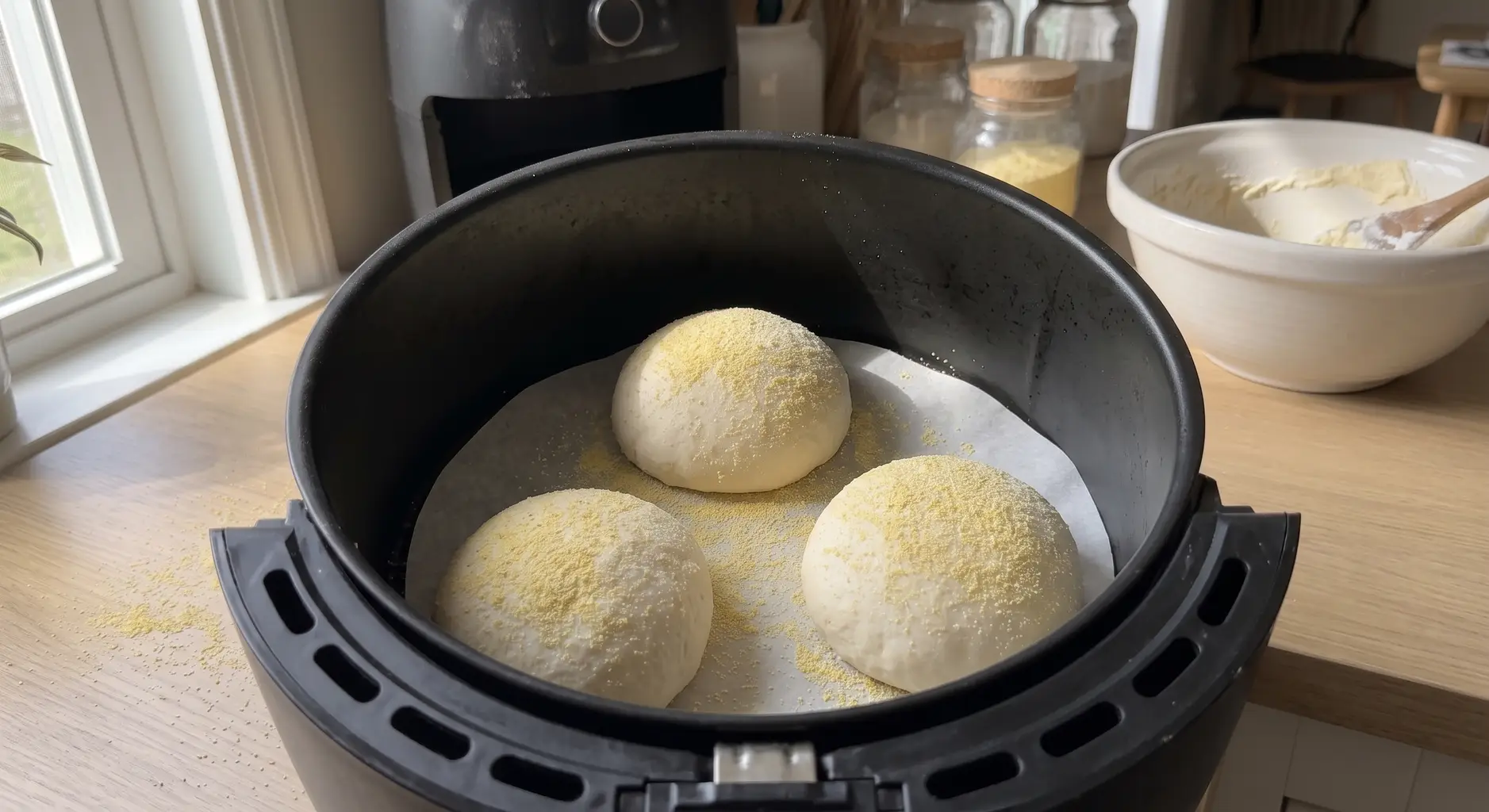
- Coat each puck in cornmeal on all sides and rest them 30 minutes on parchment, until slightly puffed.
- Preheat the air fryer at 300F for 3 minutes, then set 3 muffins on a parchment round in the basket.
- Air fry at 300F for 7 minutes, then flip each muffin with a spatula and cook 5 to 7 minutes more, until both faces are pale gold and the center reads 200 to 205F.
- Cool 20 minutes on a rack, then repeat with the second batch.
- Split with a fork around the waist, never a knife, and toast before serving.
Fixing what goes wrong
| Problem | Cause | Fix |
|---|---|---|
| Tight, even crumb, no crannies | Dough too dry, or rolled and cut | Full 72 percent hydration, and hands off: bench scraper and fingertips, never a rolling pin |
| Browned like dinner rolls | Temperature above 320°F | 300°F; pale gold is finished, brown is overshot |
| Puffed round instead of flat | No flip, so the top baked by air | Flip at minute 7; both faces need their contact turn |
| Gummy interior | Pulled early, or split hot | 200°F on the probe, then the full 20 minute rest |
| Dough impossible to handle | It is supposed to be sticky | More cornmeal on everything, lighter fingers; do not knead flour in |
| Dented or torn during the flip | Tongs, or too early | A spatula under the whole muffin, at minute 7 and not before |
Faults that turn up across every bake rather than this one live in the troubleshooting guide.
Toasting them, and store-bought ones
The other half of the internet's air fryer English muffin content is toasting instructions, so here they are, done properly: split muffin, cut faces up, 350°F for 4 to 5 minutes, no flip. The faces crisp and the ridges brown first, which is the fork-split paying off. Butter after, not before, so it melts into the valleys instead of steaming the surface. Store-bought muffins toast identically; frozen halves take 6 to 7 minutes. The 400°F the toasting posts recommend works but scorches the peaks before the valleys color, and the whole point of a craggy face is losing the race evenly. The mechanism behind that kind of tip-first scorching is in how to prevent burning in an air fryer.
This makes the machine a full breakfast station: muffins toasting while bacon waits its turn, or the whole sandwich built from the bacon and eggs method, which was practically designed to land on one of these.
Serving, storage, leftovers
Butter in the valleys is the canonical serving. Beyond that, an English muffin is the best sandwich base the breakfast shelf has: sturdier than toast, more absorbent than a roll, and the natural upgrade for anything you would put on avocado toast or under the yolk of an egg toast. Eggs Benedict exists because someone had one of these and got ambitious.
Storage: airtight at room temperature for 4 days; they hold better than most homemade breads because the interior runs moist. Freeze them fork-split, up to 3 months, and toast the halves straight from frozen; splitting before freezing is the difference between a two minute breakfast and prying at a frozen puck with a fork. Never store them anywhere near a refrigerator shelf, which stales the crumb in a day.
Doubling is two bowls of patience but only one extra basket round; the recipe scaler resizes the dough cleanly. A slower cinnamon-scented morning belongs to cinnamon rolls instead. Everything tested here is in the recipe index, and the technique pages are under guides.
Frequently asked questions
QCan I just toast store-bought English muffins in the air fryer?
Yes, and it is the best toaster most kitchens own for this job: split the muffin with a fork, faces up in the basket, 350F for 4 to 5 minutes, butter after. Frozen halves take 6 to 7 minutes with no thawing. The 400F that most toasting guides suggest chars the ridge tips before the valleys take any color; 350F browns the craggy face evenly, which is the whole reason the crags exist.
QWhy do my homemade English muffins have no nooks and crannies?
Because the bubbles were never big enough or did not survive. Big irregular holes need a wet dough, around 72 percent hydration, slack enough that it barely holds a shape; a standard bread dough ferments into a tight, even crumb no matter how long it rises. And whatever bubbles you grow have to survive shaping: a rolling pin or firm cutting presses them flat. Divide with a scraper, shape with fingertips, and split the finished muffin with a fork rather than a knife, because a blade shears the bubble walls smooth and hides the crumb you made.
QDo I need English muffin rings?
No. Rings make perfectly cylindrical muffins, and if you own some that fit your basket they work fine here, greased, with the dough spooned in at half height. But this dough holds a puck shape on its own once it is coated in cornmeal, and slightly rustic edges cost you nothing but symmetry. What rings cannot fix is a dry dough or a hot machine, which are the two failures people buy rings hoping to solve.
QWhy did mine come out like browned dinner rolls?
Temperature, almost every time. An English muffin is cooked, not baked: griddle-pale faces, white sides, thin crust. Above 320F a basket browns the whole surface and dries it into a roll, and skipping the flip does the same to the top face specifically, because it bakes in moving air instead of against the parchment. 300F, flip at minute 7, and pull at pale gold even though every instinct says it needs more color. It does not. The color it needs comes later, in the toaster.
QCan I make the dough the night before?
Yes, and you should if breakfast is the goal. Mix the dough in the evening, cover it, and refrigerate; the cold slows the yeast into a long, flavorful fermentation, and the chilled dough is noticeably easier to divide and shape than the room temperature version. In the morning, shape the pucks, give them 40 to 45 minutes of proofing instead of 30 because they start cold, and cook as written. Overnight dough makes a more sour, more open muffin, which is to say a better one.
QHow do I store and freeze English muffins?
Airtight at room temperature for 4 days, never the refrigerator, which stales bread faster than the counter. For the freezer, split every muffin with a fork first, then bag the halves; they keep 3 months and go straight from frozen into the basket at 350F for 6 to 7 minutes or into any toaster. Splitting before freezing matters more than it sounds, because a frozen whole muffin cannot be fork-split without thawing, and thawing costs you the exact morning-speed the freezer stash exists for.
Made it? Rate it.
It helps more people find the crannies.
Air Fryer English Muffins
Six fork-split muffins from a wet no-knead dough, cooked griddle-style at 300°F with one flip. Pale gold faces, white sides, open crumb.
Ingredients
- 2 cups (250g) bread flour or all-purpose flour
- ¾ cup (180ml) warm whole milk, about 105°F
- 1 tablespoon unsalted butter, melted
- 1 teaspoon instant yeast
- 1 teaspoon sugar
- ¾ teaspoon fine salt
- ¼ cup cornmeal, for dusting
Instructions
- Stir the flour, yeast, sugar, and salt together, then add the warm milk and melted butter and mix for one minute into a slack, sticky dough. No kneading.
- Cover and let it rise 60 to 90 minutes until doubled and bubbly, or refrigerate overnight for better flavor.
- Dust the counter and the dough generously with cornmeal, and turn the dough out without folding or pressing it.
- Divide into 6 with a floured bench scraper and shape each piece into a rough puck with floured fingertips, handling it as little as possible.
- Coat each puck in cornmeal on all sides and rest them 30 minutes on parchment, until slightly puffed.
- Preheat the air fryer at 300F for 3 minutes, then set 3 muffins on a parchment round in the basket.
- Air fry at 300F for 7 minutes, then flip each muffin with a spatula and cook 5 to 7 minutes more, until both faces are pale gold and the center reads 200 to 205F.
- Cool 20 minutes on a rack, then repeat with the second batch.
- Split with a fork around the waist, never a knife, and toast before serving.

Sujata Thapa
Sujata bakes everything on this site in a 5.5 quart basket air fryer on a Kathmandu counter, then re-tests the keepers until the timings hold for anyone. The English muffins spent a week losing to a rolling pin before the fingertip method put the holes back.