

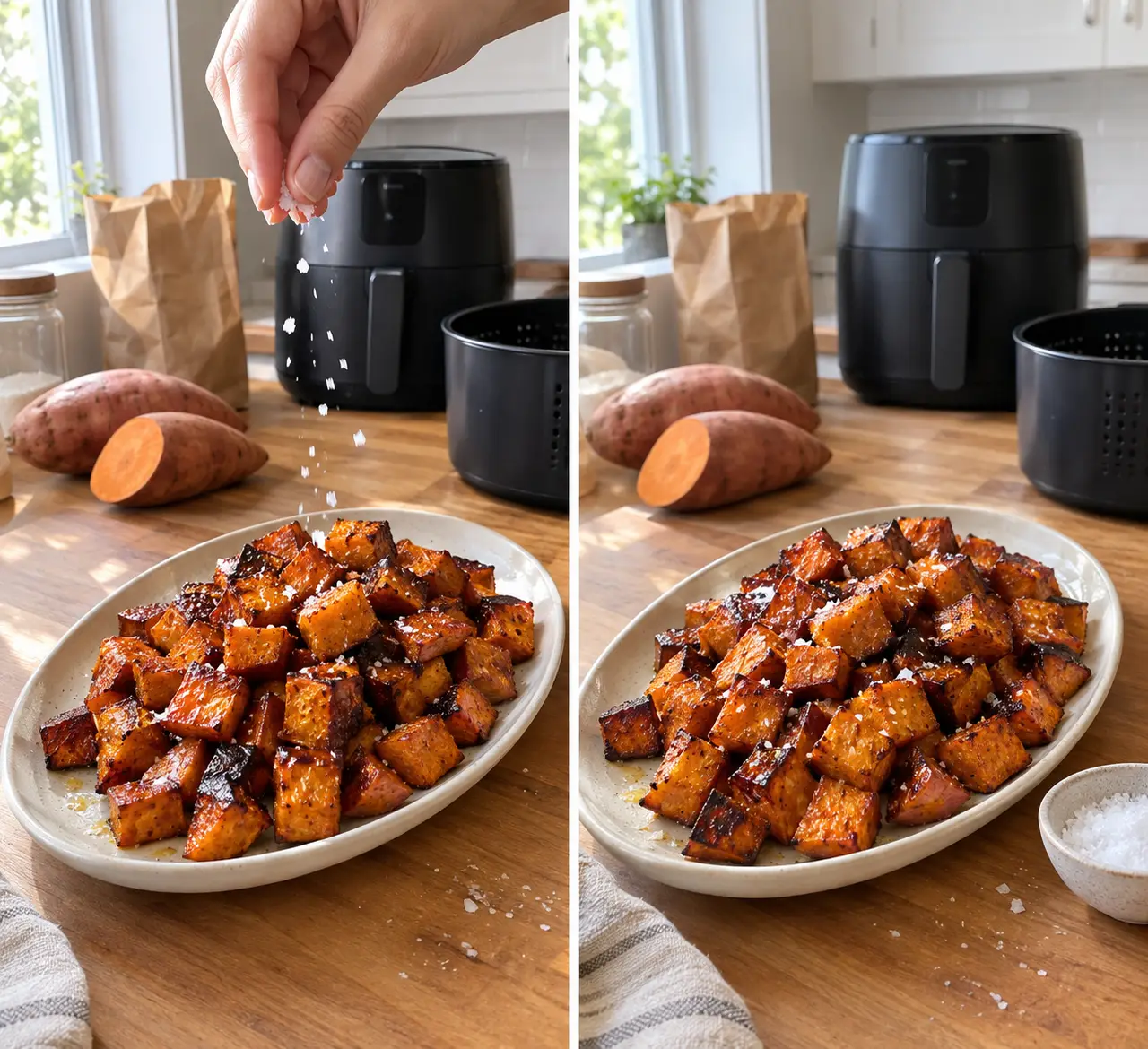
Sweet potatoes were the first savory thing I ever trusted my air fryer with, for a petty reason: my oven takes 25 minutes to preheat, and a weeknight side that needs the oven hot for 45 minutes is a side that does not get made. The basket version was on the table in 20, the edges were caramelized in a way my sheet pans never managed, and the oven stayed cold in July. That was the whole audition.
What took longer was learning why the internet's crispiest-ever promises kept underdelivering. I soaked, I cornstarched, I cranked the dial to 400, and I kept producing cubes with scorched corners and centers that tasted steamed. The fix was not another trick. It was accepting what a sweet potato actually is, and setting the machine for that vegetable instead of the one the tricks were invented for.
Quick answer: Toss 1-inch cubes with oil and salt and air fry at 380°F for 15 to 18 minutes, shaking at minute 8, until the edges are deeply browned and a fork slides in clean. For a whole baked sweet potato, prick it, rub the skin with a little oil, and run 370°F for 40 to 50 minutes, until a thermometer in the center reads 205°F or higher. No soaking, no cornstarch, no foil. Dry surface, single layer, and the right temperature do all the work.
Why sweet potatoes play by different rules
Most crispy air fryer advice was written for russets, and a sweet potato is chemically a different project. Two numbers explain nearly everything that happens in your basket:
- More sugar. A sweet potato carries several times the sugar of a white potato, and heat pushes it higher: an enzyme converts starch to maltose as the potato warms through the 135 to 170°F range. Sugar browns fast. That is why the edges of a 400°F batch can go from golden to bitter while a russet at the same setting is just getting started.
- More water, less starch. Crisp is a starch achievement. A russet fry crisps because its dry, starchy surface dehydrates into a rigid shell. A sweet potato has less starch to build that shell and more internal moisture pushing steam through it, so the surface you can realistically earn is caramelized and crisp-edged, not shatter-crisp all over.
Put together: sweet potatoes brown faster and crisp less than the vegetable most recipes are secretly calibrated for. So this recipe runs at 380°F, one step below the 400°F reflex, the same way our baking side drops a step for sweet doughs. Call it the sugar tax. The edges still caramelize hard, because sugar needs less heat to brown, but the corners stop burning before the centers turn creamy. If you have read our glossary note on caramelization, this is that chemistry doing dinner.
The honest expectation: cubes with dark, sticky, caramelized edges and fluffy interiors, and skins on whole potatoes that crackle. If a page promises french-fry crunch from fresh sweet potato cubes with no coating, it is describing a texture the vegetable cannot produce. For actual crunch, that is a battered-and-coated project, or the freezer aisle: our Alexia sweet potato fries page covers the coated kind that does shatter.
Skip the soak, do these three things instead
Half the top recipes tell you to soak cut sweet potatoes for 30 minutes; the other half never mention it. Here is the resolution: soaking rinses surface starch off starchy potatoes so fries stop gluing together. A sweet potato barely has surface starch to rinse, and what the soak reliably does is load the surface with the one thing that fights browning, which is water. I ran a side-by-side twice and the soaked batch browned slower and ended chewier both times. Skip it. These three things are what actually move the needle:
Bone-dry surface
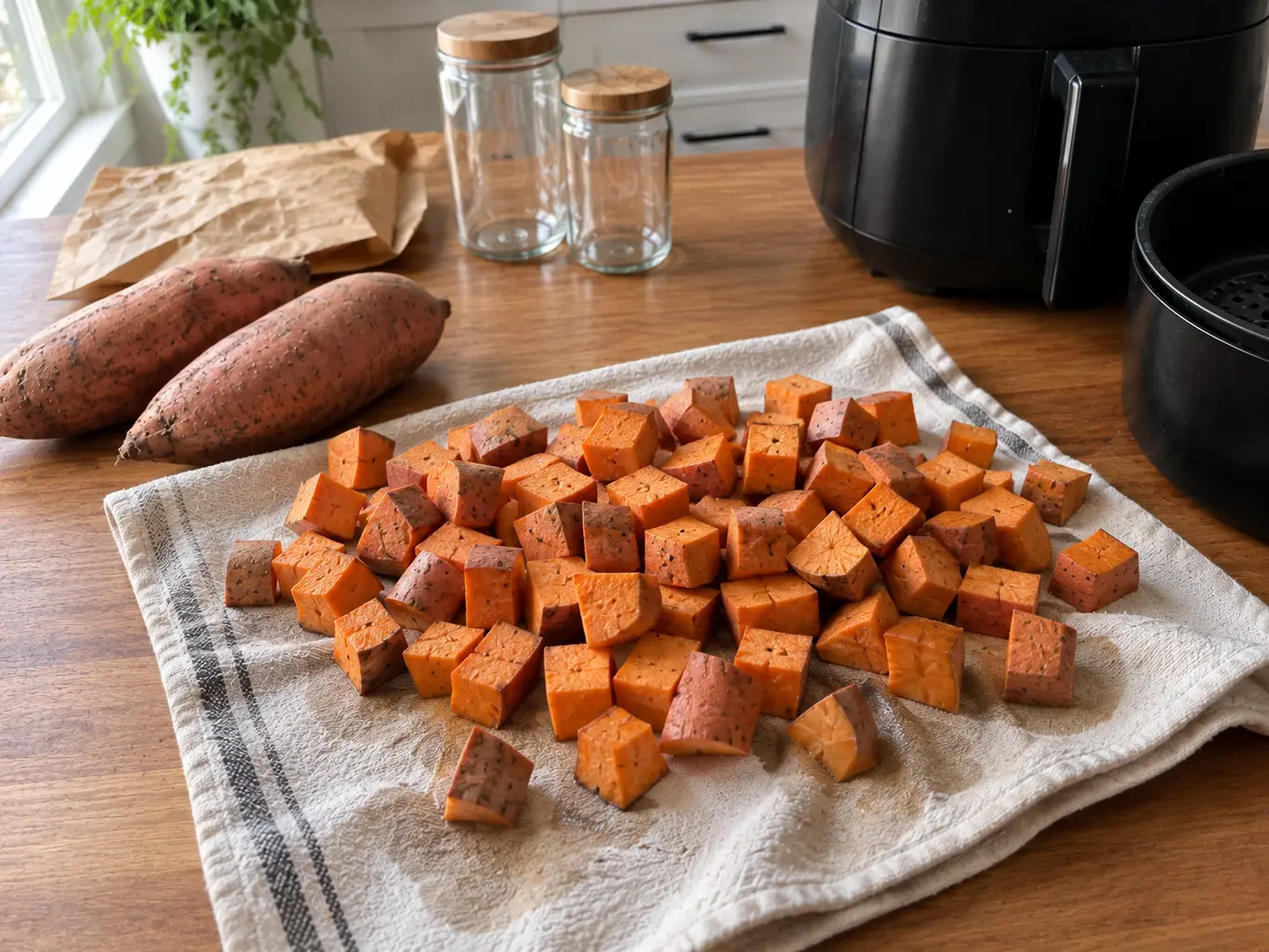
Wash, then dry the cubes like you mean it, a clean towel and a minute of rubbing. Surface water has to boil off before browning starts, and a short cook cannot afford the delay.
Real space
One layer with air between pieces. Cubes touching each other trade caramelizing for steaming, and the batch turns soft and pale. Two batches beats one crowded one, every time.
Enough oil to shine
One tablespoon per large potato, tossed until every face glosses. Oil is the heat-transfer layer that browns the edges; a dry-ish batch cooks through but never colors.
The cut decides the dish
Same vegetable, four different dinners, and the clock belongs to the cut, not the recipe. Sizes below assume a preheated basket:
| Cut | Setting | Time | What you get |
|---|---|---|---|
| 1-inch cubes (this recipe) | 380°F | 15-18 min | Caramelized edges, creamy centers. The best ratio of browning to fluff. |
| 1/2-inch cubes | 380°F | 11-13 min | More edge, less fluff. Best for bowls and salads. |
| Wedges, 8 per potato | 380°F | 16-19 min | Steakhouse-style, flip once at halfway instead of shaking. |
| Rounds, 1/2 inch | 375°F | 12-15 min | Flip at halfway. The prettiest version for serving plates. |
| Whole, 10-12 oz | 370°F | 40-50 min | Custard-soft center, crackly skin. Full section below. |
Cutting uniform matters more than cutting pretty: the smallest cube in the basket sets the moment the batch starts burning. And if your machine runs hot or cold of its dial, trust the browning cues over the clock; our air fryer calculator also converts any oven sweet potato recipe you already love, 425°F sheet-pan instructions included, into basket settings. Every setting this site has tested also lives in the air fryer baking chart.
Ingredients
The base
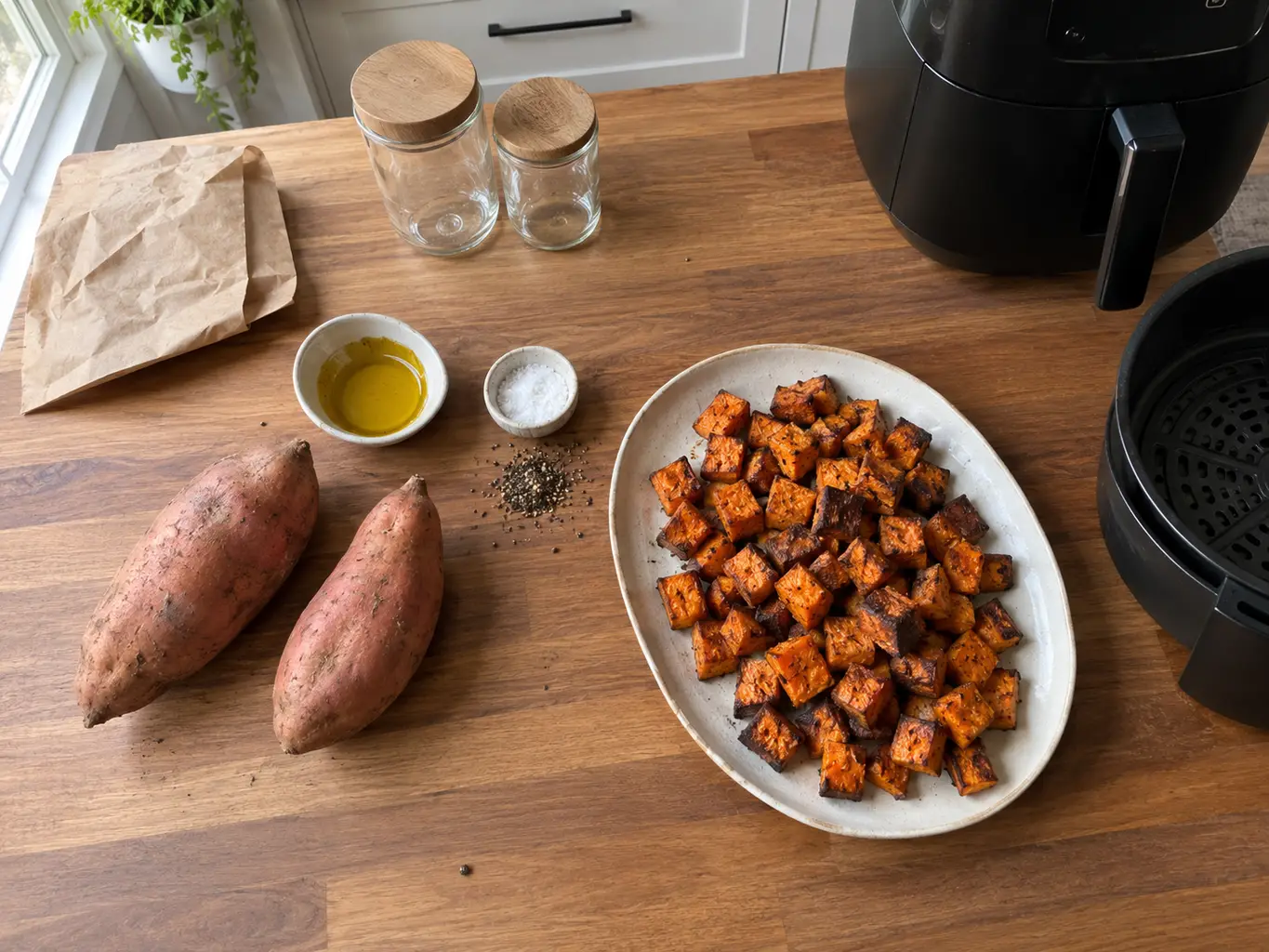
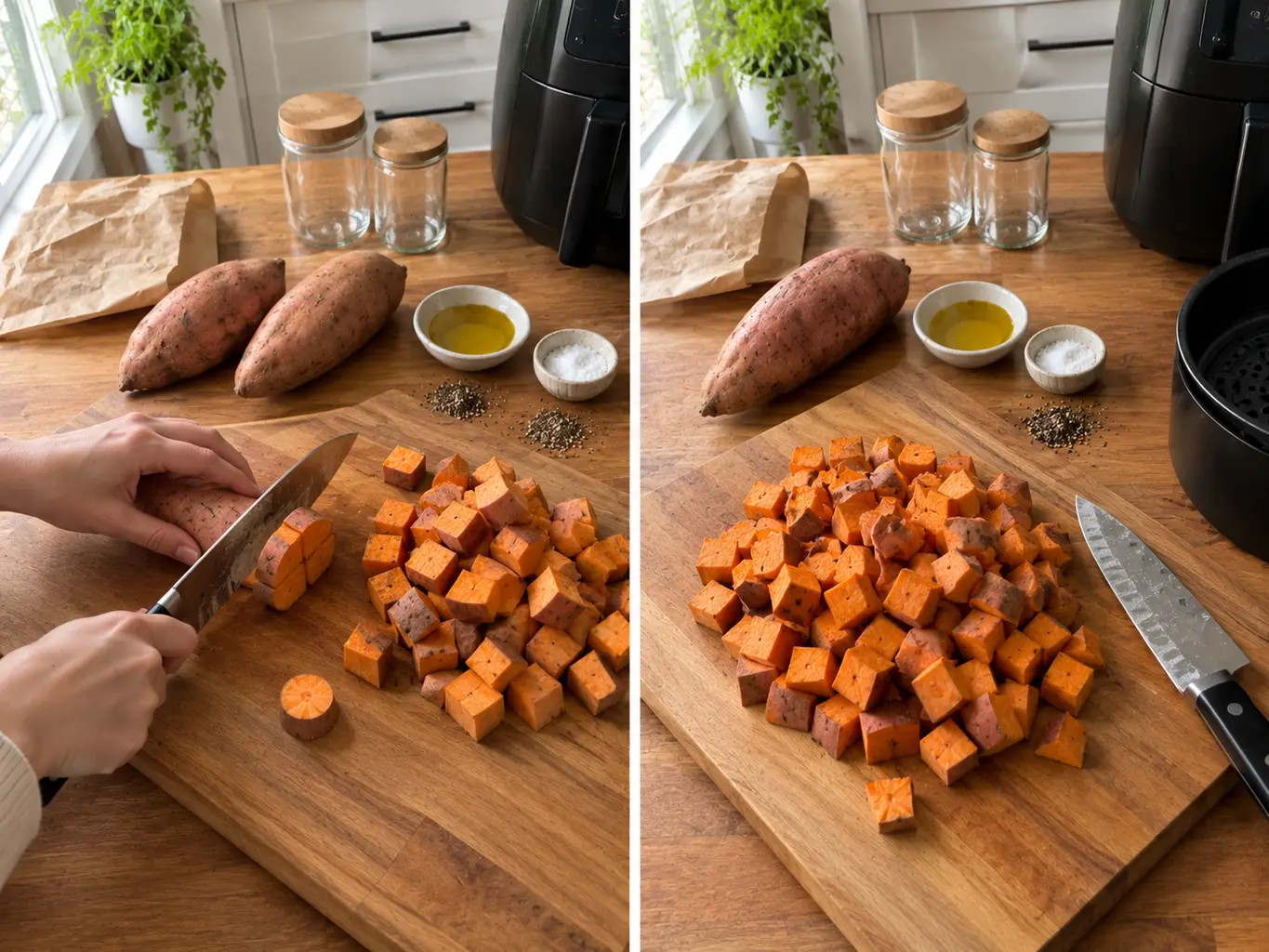
- 2 large sweet potatoes (about 1 1/2 lbs), scrubbed
- 2 tablespoons olive oil or avocado oil
- 3/4 teaspoon fine salt
- 1/2 teaspoon black pepper
Pick a direction (optional)
- Savory: 1 teaspoon smoked paprika + 3/4 teaspoon garlic powder
- Sweet: 1 teaspoon cinnamon + 1 tablespoon maple syrup, added for the last 2 minutes only
Skin on. It crisps into the best part of the cube, holds the pieces together, and saves ten minutes of peeling. The one time to peel is the maple-cinnamon direction headed for a holiday table. And maple syrup always goes on near the end: added at the start it is pure sugar in a hot basket, and you know from the section above how that story ends.
How to make them: cubes
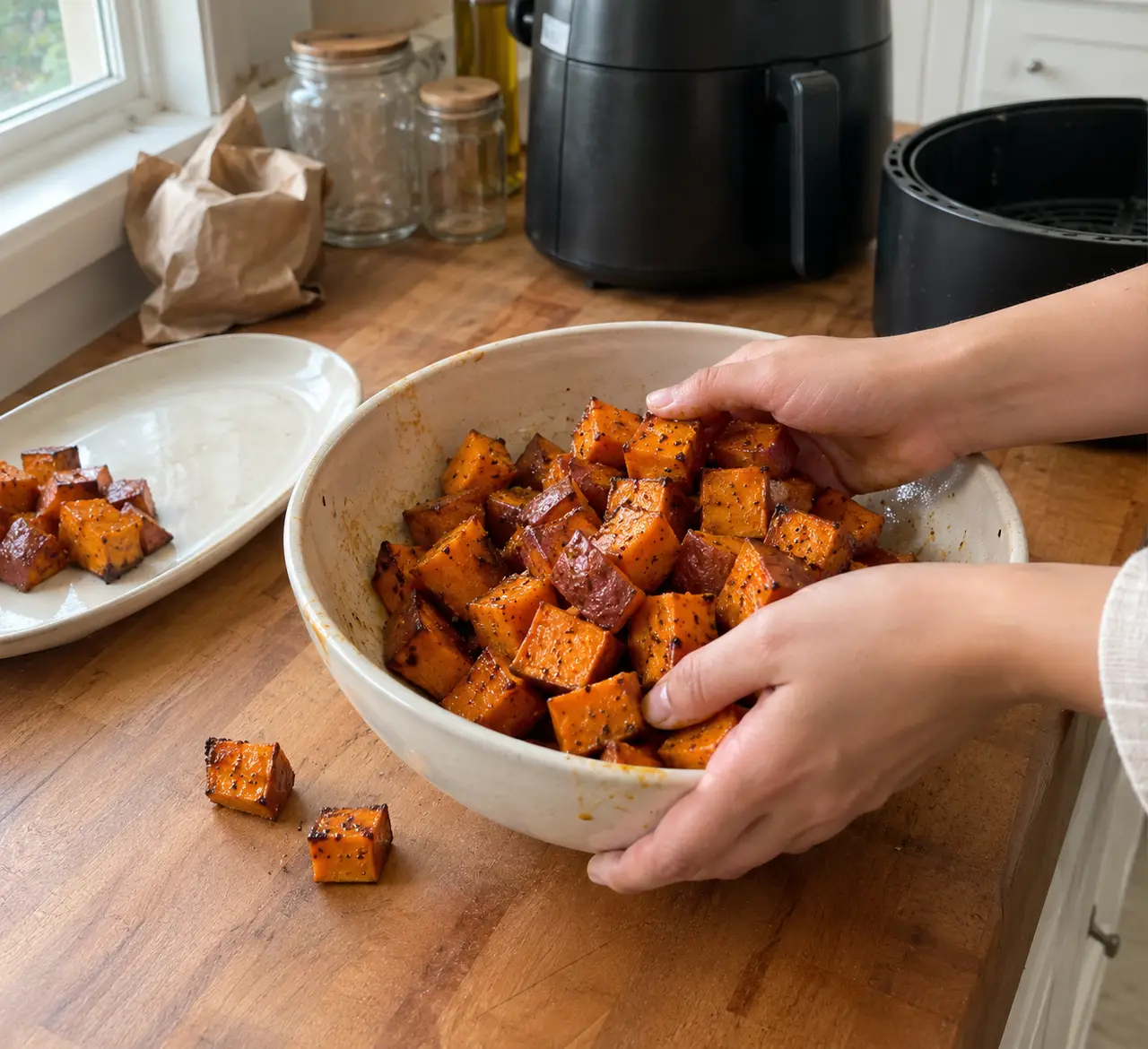
- Preheat the air fryer to 380°F for 3 minutes. A short cook wants the machine already working; the whys live in do you need to preheat an air fryer.
- Scrub, dry, and cube. One-inch pieces, as even as your patience allows, then a serious pass with a towel. Dry surfaces brown; wet ones stall.
- Toss with oil, salt, pepper and any savory spices in a bowl until every face is glossy. A bowl coats better than drizzling in the basket, and your spices stop collecting in the drawer.
- One layer in the basket, air between pieces. Half the cubes now, half in a second round, if your basket is small. Directly on the basket floor, no liner: perforations are the crisp on this one, and the parchment rules are in can you use foil or parchment paper in an air fryer.
- Air fry 15 to 18 minutes, shaking hard at minute 8. A polite wiggle rearranges nothing; toss until the pale faces trade places with the brown ones.
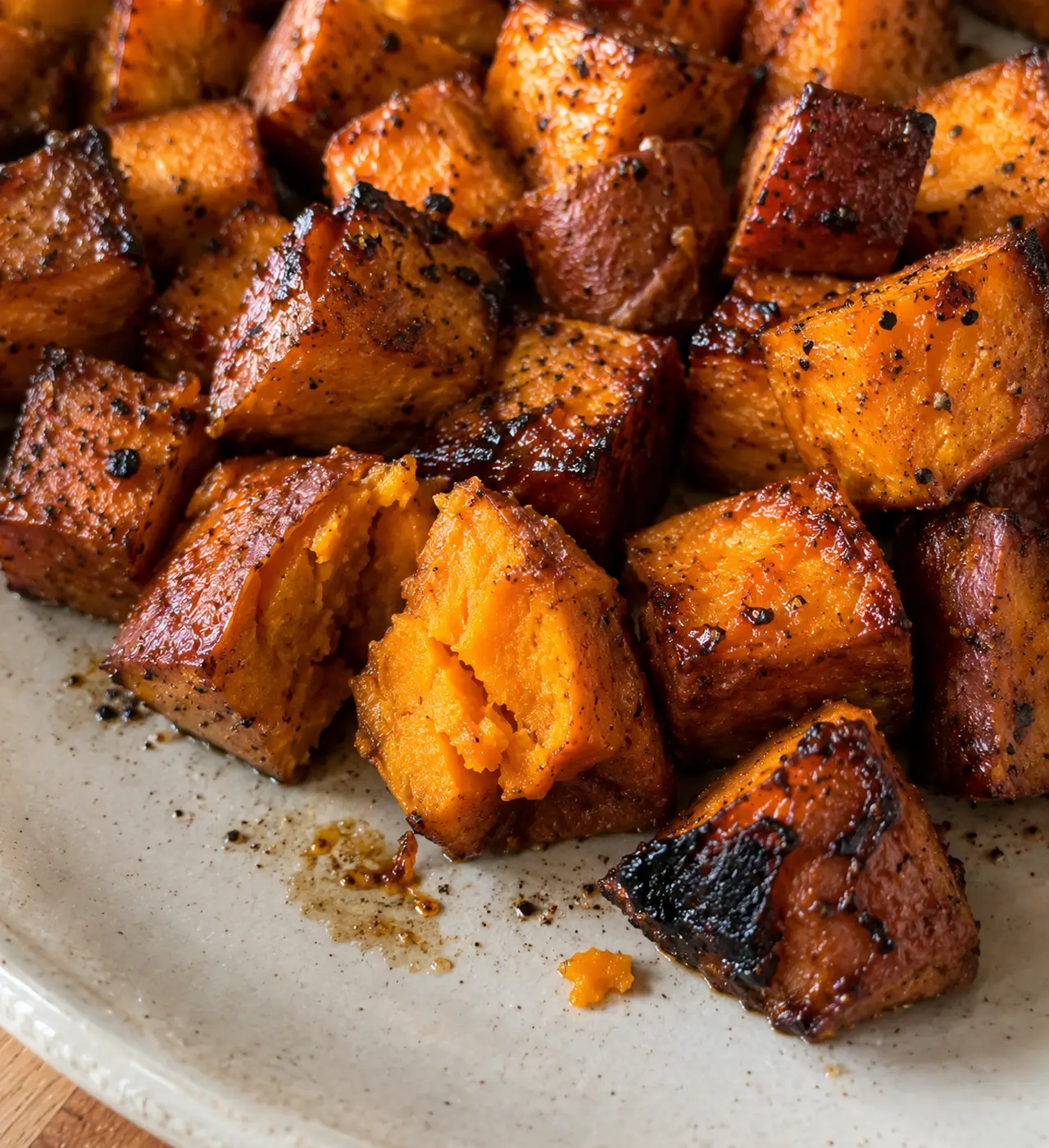
- Judge by the corners. Done is deeply browned edges with a few near-burnt corners and a fork that slides through with no push. Pale but soft means two more minutes; the color is flavor you have not collected yet.
- Season off the heat. A last pinch of flaky salt lands better on hot cubes than any amount mixed in cold. Maple-cinnamon batches get their syrup drizzle at minute 16, then 2 final minutes to set sticky.
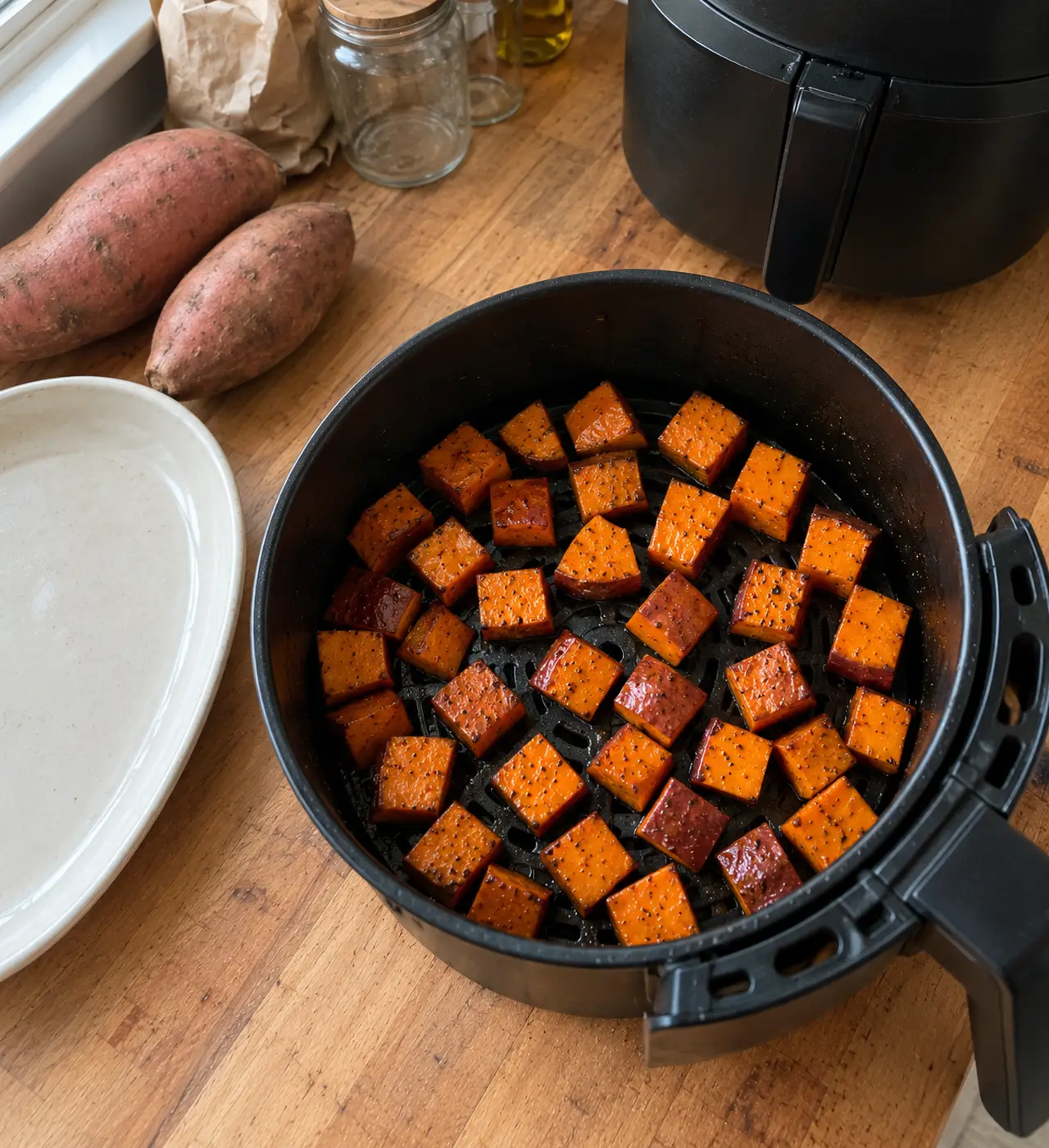
The whole baked sweet potato
The whole potato is the version the air fryer flatly outperforms an oven on. The basket's close, moving heat crisps the skin while the inside steams itself soft in its own moisture, and it does the 60-minute oven job in 45 without heating the kitchen. Three rules carry it:
- Prick it 6 or 8 times with a fork. Whole sweet potatoes build real steam pressure, and the vents keep the drama inside the skin.
- Oil the skin lightly and salt it. This is what turns the skin from a wrapper you discard into the crackly part you fight over. No foil, ever: foil steams the skin soft and adds ten minutes.
- Run 370°F for 40 to 50 minutes, and call it done by instant-read thermometer: 205°F or higher in the center. At 195°F a sweet potato is technically cooked and texturally disappointing. The last ten degrees are where the flesh slumps into custard and the sugars finish converting, which is why patient potatoes taste sweeter than rushed ones. No thermometer? Squeeze with a mitt: done gives everywhere with no firm core, and the skin has usually split somewhere on its own.
Size matters more than any timer: a 10 oz potato lands near 40 minutes, a 14 oz one nearer 55. Cook potatoes of similar size together, or accept that the big one comes out last, alone. This is the same physics as our air fryer baked potatoes, minus about five minutes, because sweet potato flesh is denser with moisture and conducts a little faster.
Doneness, by eye and by thermometer
| What you see | What it means |
|---|---|
| Cubes golden only on top faces | You skipped or under-shook the shake. Toss properly and give it 2 minutes. |
| Cubes with dark caramel edges, a couple of near-black corners, fork slides clean | Done. This is the target, and the dark corners are the best bites. |
| Cubes uniformly deep brown and collapsing | 2 minutes past. Still delicious; call them roasted and move on. |
| Whole potato at 205-212°F, skin split, syrup beads at the vents | Perfect. Those caramel beads are the sign the sugars finished converting. |
| Whole potato at 190-200°F, firm handshake in the middle | Cooked but not creamy. 5 to 8 more minutes repays you double. |
Cubes keep cooking for a minute or two out of the basket, the same carryover that finishes a tray of cookies, so pull them at done rather than past it.
Troubleshooting
| What you got | Why | Fix |
|---|---|---|
| Soft, pale, steamed-tasting cubes | Crowded basket, almost always. Second suspect: wet surfaces. | One layer with air between pieces, and towel-dry after washing. Two batches beat one pile. |
| Burnt corners, firm centers | Temperature too high for the cube size, the sugar problem in action. | 380°F, not 400. Big cubes and high heat is the one combination that cannot win. |
| Chewy, leathery edges | The soak. Waterlogged surfaces brown late and toughen. | Skip soaking entirely; it is a russet technique that came along for the ride. |
| Bland despite seasoning | Spices went in wet or rode loose in the basket. | Toss in a bowl with oil first, and finish with flaky salt while hot. |
| Stuck to the basket | Not enough oil in the toss, or the basket needed cleaning. | Every face glossy before loading, and see the bakeware cleaning guide for the sticky-basket cure. |
| One side of the basket always darker | A hot spot, standard machine behavior. | Shake at minute 8 with a quarter-turn of the basket. Persistent scorching lives in how to prevent burning in an air fryer. |
| Whole potato oozing before soft | Nothing wrong: syrup escaping the vents is normal and correct. | Keep going to 205°F. Put a liner under the basket next time for cleanup only, never around the potato. |
| Second batch cooked faster and darker | The basket floor holds heat between rounds. | Knock a minute off later batches, and judge by color, not the clock. |
Faults that turn up across every bake rather than this one live in the troubleshooting guide.
Variations
- Maple, cinnamon and candied walnuts. The sweet direction from the ingredients list, finished with a handful of chopped air fryer candied walnuts. Close enough to casserole to retire the marshmallow version.
- Smoky taco filling. Savory direction plus 1/2 teaspoon cumin and a pinch of chipotle. Half-inch cubes, 11 to 13 minutes, straight into tortillas with black beans.
- Loaded whole. The baked potato treatment: butter, flaky salt, or go full dinner with chili and cheddar. Sweet potato plus chili is the best argument the whole method has.
- Herb and garlic. Toss the finished cubes with a grated garlic clove and chopped rosemary while hot. The residual heat blooms the garlic without burning it.
- Breakfast hash. Half-inch cubes cooked crisp, then folded into a pan with air fryer bacon and a fried egg. Better than our hash browns? Different church, same religion.
On the sides shelf, these rotate with baby potatoes, asparagus, frozen brussels sprouts and corn on the cob, and the showpiece version of the potato genre is the accordion potato. For the plate they usually land beside, the Italian sausage and the chicken drumsticks both run in the same basket on their own night.
Storage, reheating and meal prep
- Fridge: 4 days airtight, cubes or whole. They reheat better than almost any vegetable because the interior was creamy to begin with.
- Reheat cubes: 380°F for 3 to 4 minutes, straight from the fridge. The edges re-crisp to nearly day-one. The microwave works but returns them to steamed.
- Reheat whole: 350°F for 8 to 10 minutes, or split it, microwave 90 seconds, then 3 basket minutes for the skin.
- Meal prep the smart direction: cook fully, then reheat portions through the week. Raw cut sweet potatoes brown and dry out in the fridge; cooked ones just wait.
- Freeze: whole baked flesh freezes fine for 3 months and becomes future mash or pie filling. Cooked cubes freeze but return softer; call them curry and soup material, not sides.
Frequently asked questions
QHow long do sweet potatoes take in an air fryer?
One-inch cubes take 15 to 18 minutes at 380°F with a shake at minute 8. Half-inch cubes run 11 to 13 minutes, wedges 16 to 19, and a whole 10 to 12 oz sweet potato needs 40 to 50 minutes at 370°F. The cut sets the clock, so match the timer to the knife work, not to a single number from any recipe, this one included.
QWhat temperature is best for sweet potatoes in an air fryer?
380°F for cubes and wedges, 370°F for whole. Sweet potatoes carry far more sugar than white potatoes, and sugar browns at lower temperatures, so the 400°F setting that suits a russet scorches sweet potato corners before the centers finish. One step down buys even caramelization and creamy middles for the cost of about two extra minutes.
QShould you soak sweet potatoes before air frying?
No. Soaking exists to rinse surface starch off high-starch potatoes like russets so fries do not stick together. Sweet potatoes are low-starch and high-moisture, so the soak removes little and leaves the surface wet, which delays browning and turns edges chewy. Drying the cut pieces thoroughly with a towel does more for browning than any soak.
QDo you peel sweet potatoes before air frying?
No need. The skin is thin, crisps beautifully at the cube edges, holds pieces together through the shake, and carries a good share of the fiber. Scrub well and dry. Peel only for smooth-textured applications, like a maple-cinnamon batch headed for a holiday plate or cubes destined for mash.
QWhy are my air fryer sweet potatoes soggy?
Almost always a crowded basket. Pieces stacked or touching release steam onto each other faster than the fan can clear it, so they poach instead of brown. Wet surfaces from washing or soaking cause the same stall. One layer with visible gaps, towel-dried pieces, and a hard shake at halfway produce caramelized edges every time.
QHow long does a whole sweet potato take in an air fryer?
40 to 50 minutes at 370°F for a typical 10 to 12 oz potato, up to 55 for a large one. Prick it several times, oil and salt the skin, and skip the foil, which only steams the skin soft. The reliable done signal is a center temperature of 205°F or higher; below that the flesh is cooked but not yet creamy.
QCan you stack sweet potatoes in an air fryer?
Not if browning is the goal. Stacked cubes steam each other pale and soft. If the batch does not fit in one layer with a little air between pieces, split it: two 16-minute rounds beat one 25-minute pile, and the second round runs about a minute faster because the machine is fully heat-soaked. Whole potatoes can sit side by side freely as long as air moves between them.
QCan you air fry frozen sweet potato cubes?
Yes, straight from the bag with no thawing: 380°F for 18 to 22 minutes with two shakes. Expect softer results than fresh, since freezing ruptures cells and releases extra water. Skip added oil for the first 10 minutes, then toss with oil and seasoning and finish. For coated frozen fries, follow our Alexia sweet potato fries settings instead.
QAre air fryer sweet potatoes healthy?
They hold up well: a serving here carries about a tablespoon and a half of oil across four people, versus the deep fryer's much larger contribution to restaurant sweet potato fries. The potato itself brings fiber, potassium and a large dose of vitamin A. Skip the maple variation and use a teaspoon less oil and the numbers improve further, at a modest cost in edge color.
Never overbake again
Get our one-page times & temps cheat sheet, plus a new tested recipe each week.
No spam · unsubscribe anytime