

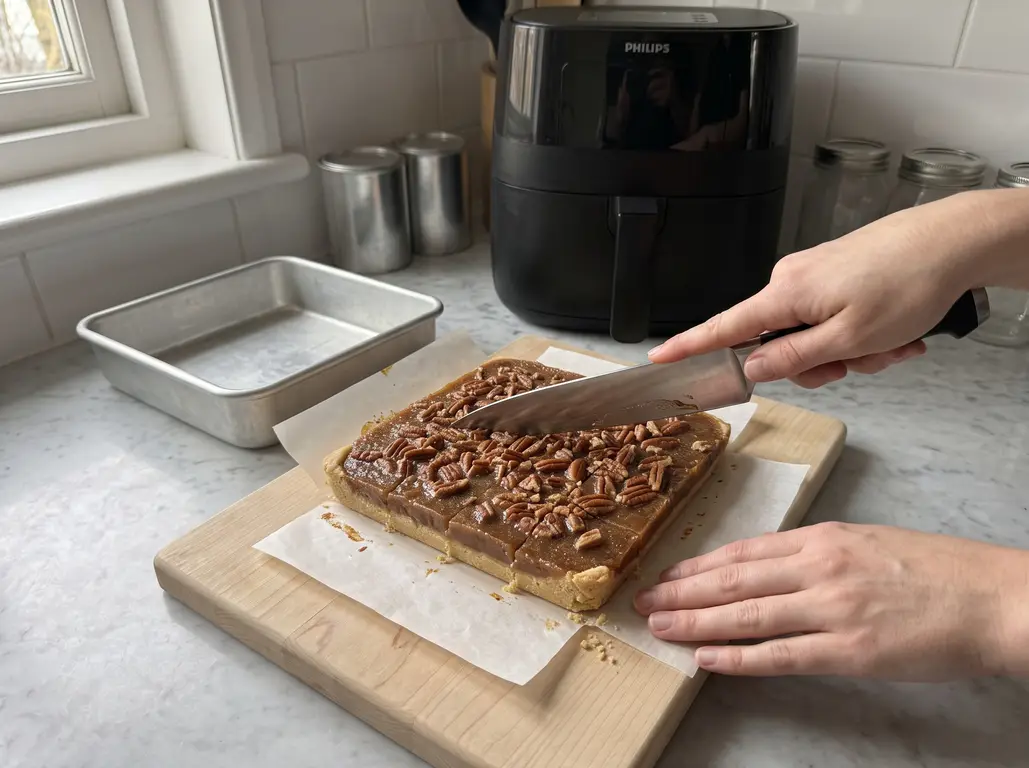
Pie bars versus caramel bars, honestly
Search this keyword and most of what you find is a bar made by simmering butter, sugar, syrup and milk on the stove and pouring it over a crust. That is a perfectly nice dessert, and it is not a pecan pie bar; it is a caramel bar with pecans in it, soft at room temperature, fudgy rather than gooey, and missing the one thing that makes pecan pie taste like pecan pie: the egg-set filling. Eggs are what turn syrup and sugar into that translucent, sliceable gel with the shattering top skin, and they are also what makes the bake a matter of temperature rather than time.
So this recipe is our pecan pie with the geometry changed and nothing else. Same filling chemistry, same in-place pecan toasting, same 200°F finish line. What the bar form buys you is everything the pie makes difficult: no crust to roll, crimp or blind bake with weights, a press-in floor that takes four minutes of effort, and a dessert that travels, stacks and gets eaten out of hand. It is the version to bring somewhere, and the pie is the version to serve at your own table.
The pan that actually fits
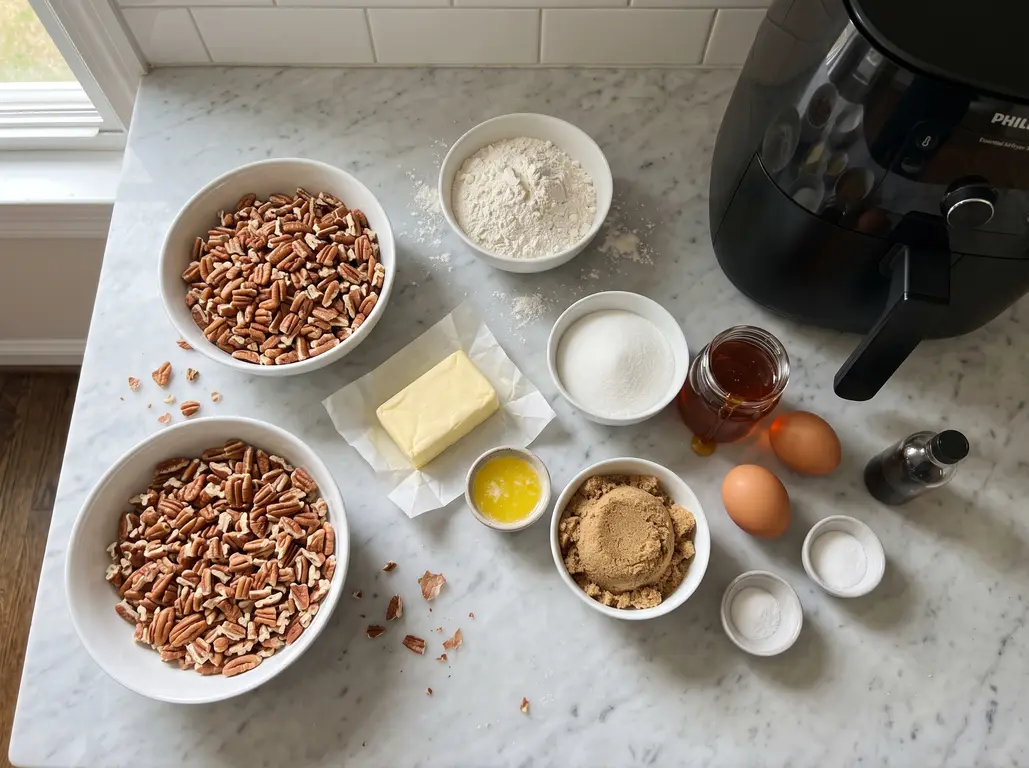
The one real air fryer pecan bar recipe in the results calls for an 8x8 pan, and an 8x8 pan does not fit a 5 to 6 quart basket; wedge one in and it blocks the airflow the machine cooks with, which is how corner bars end up pale while the center scorches. This recipe is written for a 7 inch pan, square or round, the same size that runs our magic bars and cheesecake bars, sitting in the basket with air on every side. The pan size calculator confirms your own machine's clearance before the butter comes out, and if you genuinely run an oven-style unit that takes an 8 inch, the recipe scaler grows everything by a third in one pass.
Line it with a parchment sling, two crossed strips overhanging the sides, the house move on every bar page from the blondies on down. Sticky filling plus a fixed pan equals archaeology; the sling lifts the whole slab out in one piece and turns cutting into a countertop job.
A shortbread floor, baked alone
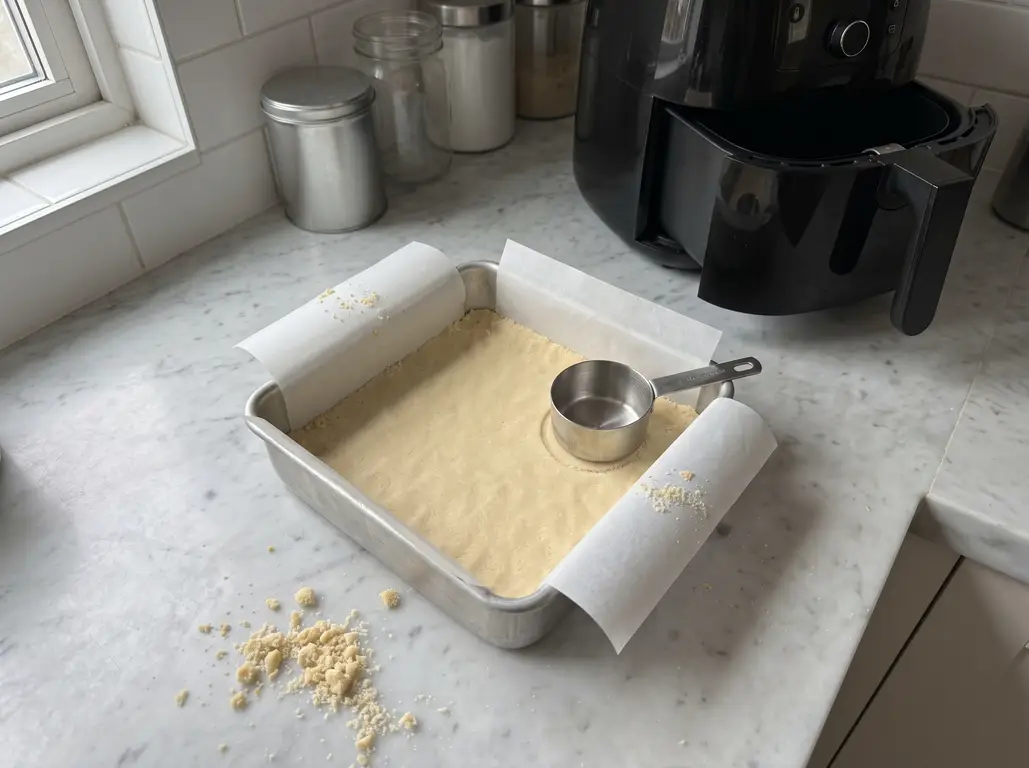
The crust is a true shortbread, the same 1:2:3 butter-sugar-flour family as our shortbread cookies and the floor under the lemon bars, pressed flat with the base of a measuring cup instead of rolled. It bakes alone first, at 320°F for 10 to 12 minutes, until set and pale gold, because a raw floor under a wet filling steams instead of baking, and the bottom of a basket is exactly where an air fryer is gentlest. Then the rule the lemon bars taught this site: the filling pours onto the crust while the crust is still hot. A hot floor starts setting the custard layer it touches on contact, which glues filling to crust; let it cool and the two bake into separate layers that part company at the first bite.
The pecans toast themselves
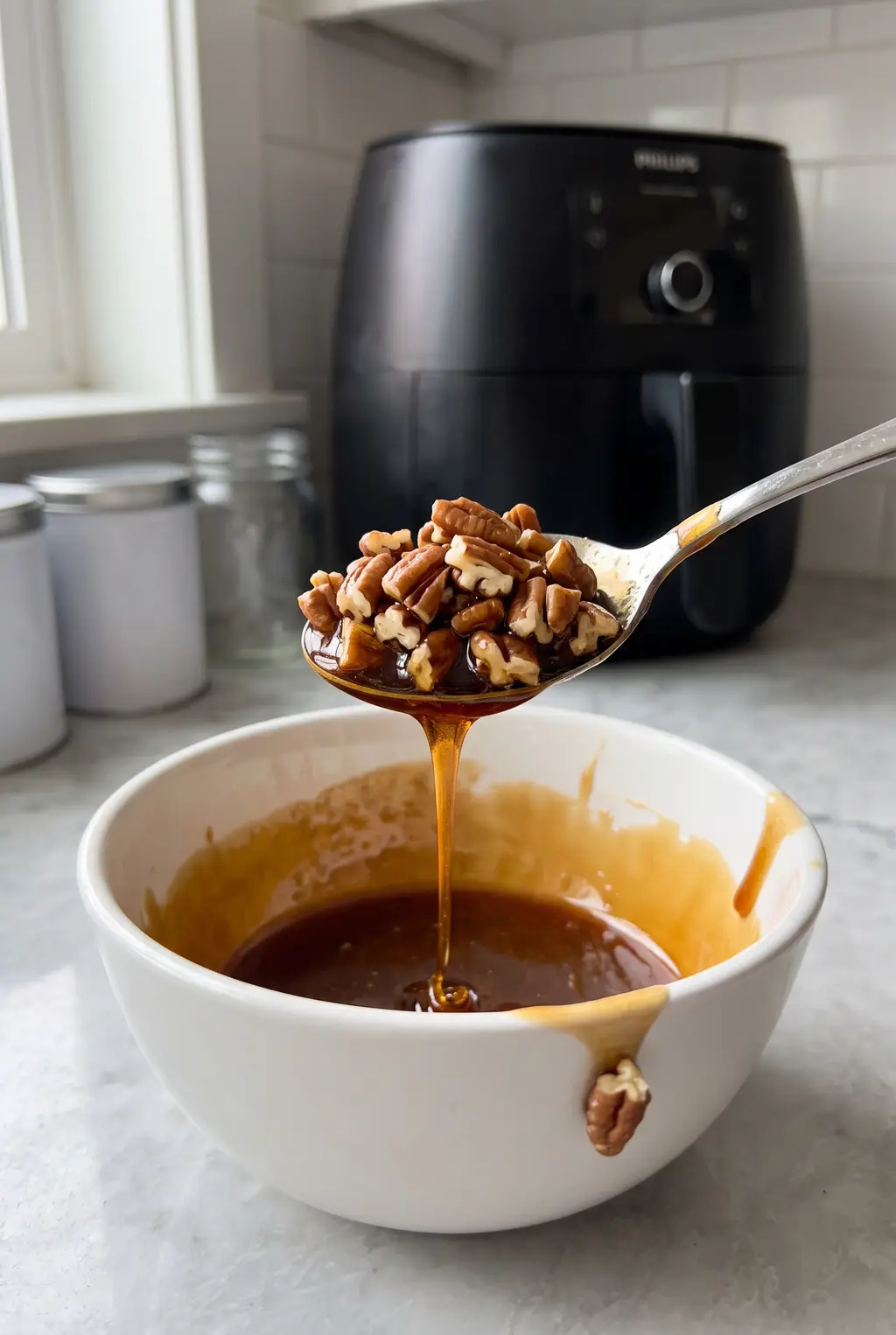
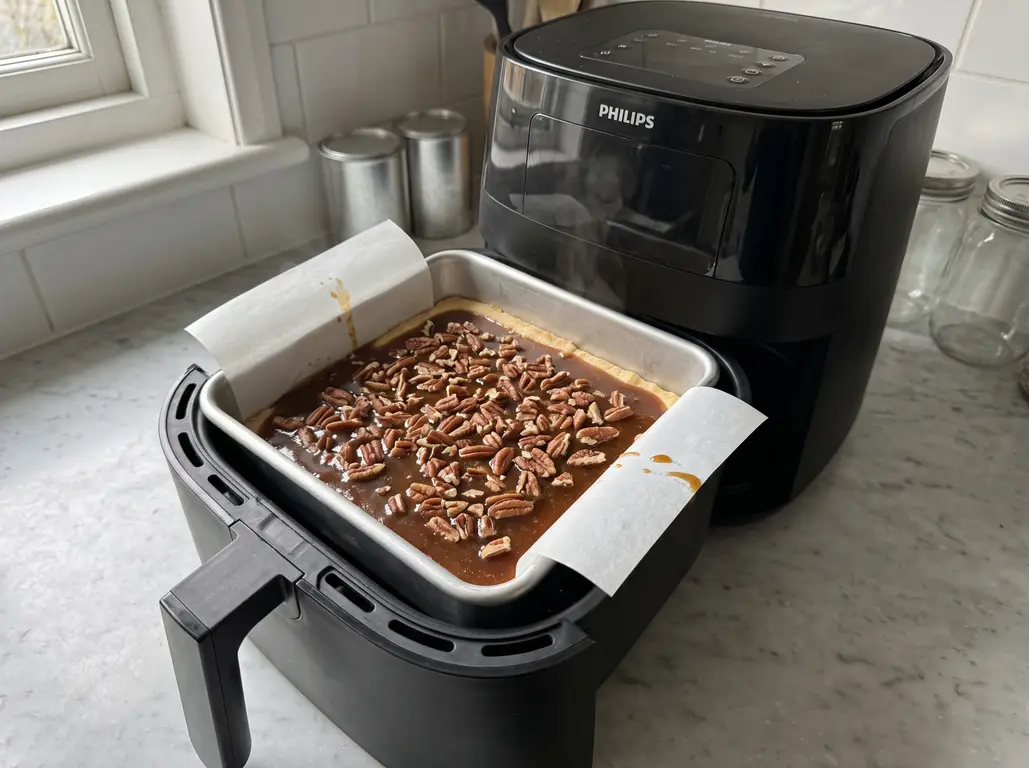
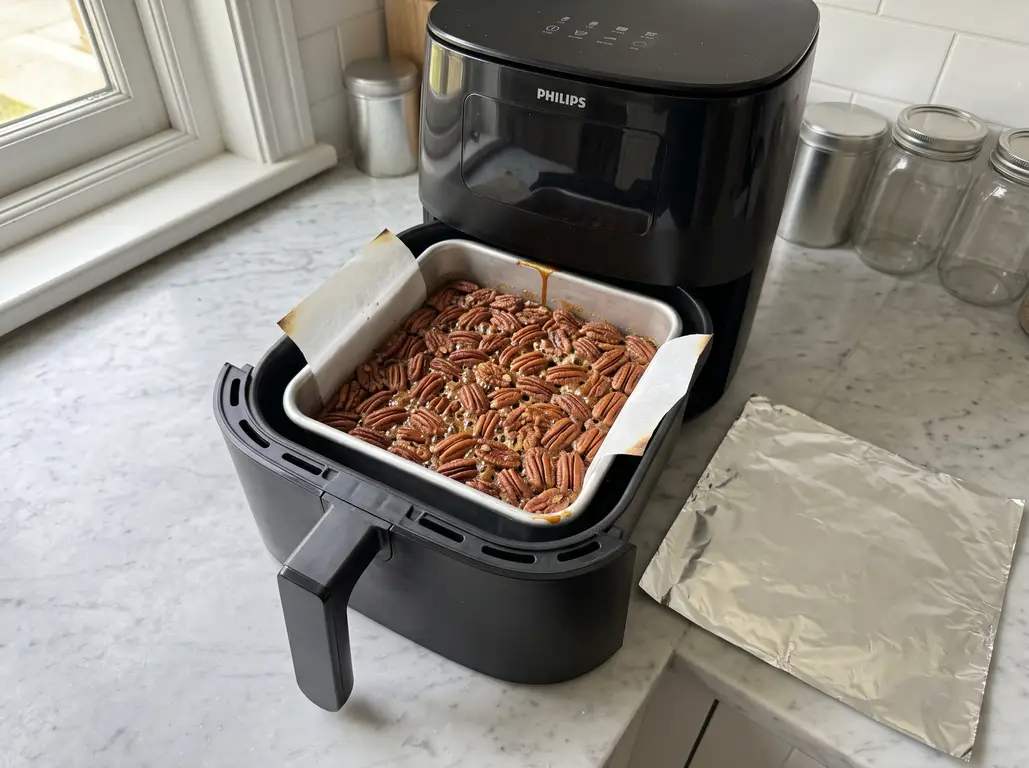
Chopped pecans are lighter than the syrup they sit in, so they float to the surface as the filling heats, and that float is a gift: the first 12 to 14 minutes at 300°F run uncovered, and the element toasts the pecan layer right on the bars, deeper and more evenly than a separate toasting pan would manage. The moment they reach deep golden, a flat sheet of foil goes over the pan and stays for the rest of the bake, so the nuts stop where they are while the custard underneath finishes. It is the exact toast-then-shield sequence from the pecan pie, and a full pan of sticky filling is the textbook safe case for resting foil in a basket, per the foil and parchment guide. If your machine browns everything ahead of schedule regardless, its file is in the burning guide.
200°F, and why color lies twice
Color misleads on these bars in both directions. The top looks done early, because toasted pecans and bubbling syrup look finished long before the eggs underneath have set; and it looks underdone late, because a fully baked filling still wobbles when the pan moves. The number that cannot be argued with is 200°F on a thermometer at the center, the same setting point every syrup-dense pecan custard shares, sitting at the top of this site's custard ladder above the pumpkin cheesecake's 170 and the pumpkin pie's 175. At 200 the filling is a gel that slices; ten degrees further and the sugar is on its way to candy, which is where hard, tooth-pulling pecan bars come from. Pull at the number while the center still moves like slow syrup, and let carryover spend the pan's stored heat finishing the middle on the rack. Converting a family oven recipe for pecan bars instead? The air fryer calculator turns its 350°F directions into a basket setting, and this page's numbers live with everything else on the baking chart.
The clean-cut protocol
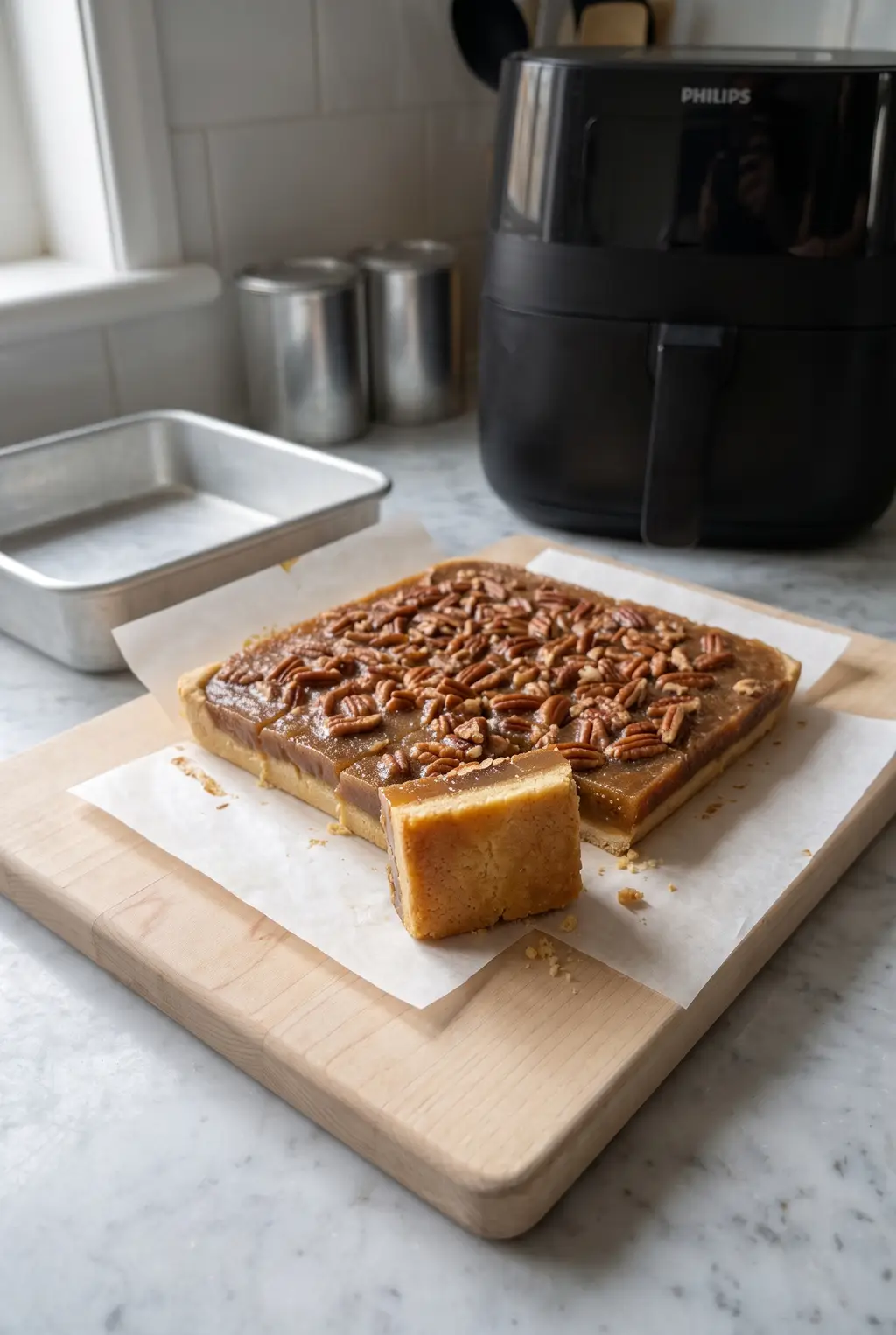
Every crumbled, smeared pecan bar was cut too warm. The filling needs its full cooling arc to firm: 1 hour in the pan on a rack, then 1 hour in the refrigerator, and only then does the sling lift the slab onto a board. Cut with a long knife pressed straight down in one motion, never sawed, and wiped clean between cuts; sawing drags pecans through the custard and paints the shortbread with filling. Sixteen squares from a 7 inch pan sounds small until you pick one up: this is the densest sweet on the site's bar shelf, and a two-bite square is the honest portion. Serve them cool or at room temperature; a 10 second warm-up makes them gooey again and costs the clean edge you just earned.
Ingredients
For 16 bars, one 7 inch pan
- Crust: 1 cup (125g) all-purpose flour
- Crust: 1/2 cup (113g) butter, softened
- Crust: 1/4 cup (50g) granulated sugar
- Crust: 1/4 teaspoon fine salt
- Filling: 2 large eggs
- Filling: 1/2 cup dark corn syrup
- Filling: 1/2 cup packed brown sugar
- Filling: 3 tablespoons butter, melted
- Filling: 1 teaspoon vanilla extract
- Filling: 1/4 teaspoon fine salt
- 1 3/4 cups (200g) pecans, roughly chopped
- A 7 inch pan and a parchment sling
Dark corn syrup for the deepest flavor, light for a gentler one; both set identically. Chop the pecans roughly, not fine: fine-chopped nuts sink instead of floating, and the toast-in-place trick needs them on top.
How to make them
- Cross two strips of parchment in a 7 inch pan, edges overhanging two sides, and lightly grease the exposed walls.
- Beat the softened butter with the sugar and salt, work in the flour to coarse crumbs, and press them into an even, firm floor with the flat base of a measuring cup.
- Bake the crust at 320F for 10 to 12 minutes, until it is set and pale gold at the edges.
- While the crust bakes, whisk the eggs, corn syrup, brown sugar, melted butter, vanilla and salt until smooth, then stir in the chopped pecans.
- Pour the filling over the crust the moment it comes out, while it is still hot, and nudge the pecans into an even layer.
- Bake at 300F, uncovered, for 12 to 14 minutes, until the floated pecans turn deep golden. Lay a flat sheet of foil over the pan and keep baking.
- Bake 10 to 14 minutes more under the foil, until a thermometer reads 200F at the center. The middle should still have a slow, syrupy wobble; it sets as it cools.
- Cool 1 hour in the pan on a rack, then refrigerate 1 hour. Lift the slab out by the sling and cut 16 squares with a long knife pressed straight down, wiped between cuts.
Variations
- Maple pecan bars: swap the corn syrup for pure maple syrup, same measure, same 200°F. The set lands slightly softer because maple carries more water, so give them the full chill before cutting. This is the version half the search results are actually making; it is legitimate, and it is a different, looser bar.
- Bourbon: a tablespoon whisked in with the vanilla. It bakes down to warmth and a rumor.
- Chocolate chip: a half cup of chips scattered over the hot crust before the filling pours on, where they melt into a thin dark seam between floor and filling.
- Salted tops: a pinch of flaky salt the moment the foil comes off. On a filling this sweet, it does the work of a second flavor.
- Candied crunch: chop a handful of our candied walnuts over the finished bars for a double-nut version that gets asked about.
Fixing what goes wrong
| Problem | Cause | Fix |
|---|---|---|
| Runny middle | Pulled before 200°F, or cut warm | Bake to the number, then the hour-and-hour cooling arc before the knife |
| Hard, chewy, tooth-pulling bars | Baked past about 205°F; the syrup moved toward candy | 200°F is a pull point, not a minimum. Check early on a hot-running machine |
| Filling and crust separate | Filling poured onto a cooled crust | Pour the moment the crust comes out; hot shortbread glues the layers |
| Pecans dark before the filling set | No foil shield, or a shield that went on late | Foil at deep golden, around minute 12 to 14, pressed flat at the rim |
| Soggy, pale floor | Crust skipped its solo bake | 320°F for 10 to 12 minutes alone, every time |
| Crumbled, smeared cuts | Sawing, or a warm slab | Chilled slab, straight-down press, knife wiped between cuts; deeper mysteries live in the troubleshooting guide |
Storage, and the freezer trick
Airtight, these hold 3 days at room temperature or a week refrigerated, and they are quietly better on day two, once the filling has fully settled into the crust. The freezer is where they outclass the pie entirely: cut squares layered between parchment freeze for 2 months and thaw in half an hour on the counter, which means the Thanksgiving dessert can be finished before November even starts. The pie they came from and the rest of the make-ahead shelf, the lemon bars and cheesecake bars included, live one shelf over in the cookies and bars collection. For the rest of a holiday dessert table, the sweet potato pie is at its best made a day ahead, and the pumpkin cookies bake in 9 minute batches.
Frequently asked questions
QWhat temperature do you bake pecan bars in an air fryer?
Two stages in a 7 inch pan: the shortbread crust bakes alone at 320°F for 10 to 12 minutes, then the filling goes on and the pan drops to 300°F for 22 to 28 minutes total, uncovered until the pecans toast golden and under a flat foil sheet after that. The finish line is a thermometer reading of 200°F at the center, not a look; pecan filling is a sugar-dense custard, and 200°F is the temperature where it sets into a sliceable gel.
QWhy are my pecan bars runny in the middle?
They came out before the custard reached its setting point. A pecan filling is eggs, syrup and sugar, and that mixture does not firm until the center hits 200F; bars pulled at golden-and-bubbling can still be ten degrees short. The second suspect is cutting warm, because even a fully baked filling is soft until it cools and chills. Bake to the number, give the slab its hour on the counter and hour in the refrigerator, and the squares hold a clean edge.
QCan I make pecan bars without corn syrup?
Yes, with an honest trade. Swap the corn syrup for an equal measure of maple syrup and you get the maple pecan bar the internet loves, with a slightly softer set and a looser slice, because maple carries more water and less of the long glucose chains that make corn syrup set firm. Honey works the same way and tastes louder. Bake to the same 200F either way, and lean on the refrigerator chill a little harder before cutting.
QDo I need to toast the pecans first?
No, and skipping the separate step is deliberate. Chopped pecans float to the top of the filling as it bakes, so the first uncovered stretch at 300F toasts them right on the bars, the same in-place toasting the pecan pie on this site uses. The foil sheet then stops them at deep golden while the custard underneath finishes. Pre-toasting on top of that double-cooks them into bitterness; the one exception is pecans destined for the crust in the variation that adds them there.
QWhy did the bars come out hard and chewy instead of gooey?
Overbaked sugar. Past about 205F the syrup keeps concentrating, and every degree after that moves the filling from soft caramel toward candy; bars that shatter or pull at your teeth spent too long in the heat, usually because they were judged by color instead of temperature. Pull at 200F while the center still wobbles slowly, and remember the filling keeps cooking for a few minutes in the pan. If your machine runs hot, check five minutes early the first time.
QCan I bake these in an 8 inch pan?
If your basket truly fits one with air around it, yes: scale everything up by about a third and expect a couple of extra minutes to reach 200F, since the layer stays about the same depth. Most 5 to 6 quart baskets do not fit an 8 inch pan with breathing room, which is why this recipe is written for 7 inches; a pan wedged against the basket walls blocks the airflow the machine cooks with, and the corners pay for it.
QHow do you store pecan bars, and do they freeze?
Airtight at room temperature for 3 days or refrigerated for a week; the chill firms them pleasantly and the flavor deepens by day two. They also freeze better than almost any bar on this site: layer the cut squares between parchment in a container for up to 2 months and thaw at room temperature for half an hour. That makes them the rare holiday dessert you can finish two weeks early, which is exactly how they earn their spot in November.
Made it? Rate it.
Never overbake again
Get our one-page times & temps cheat sheet, plus a new tested recipe each week.
No spam · unsubscribe anytime